Showing posts with label japan. Show all posts

Monday, 11 November 2013

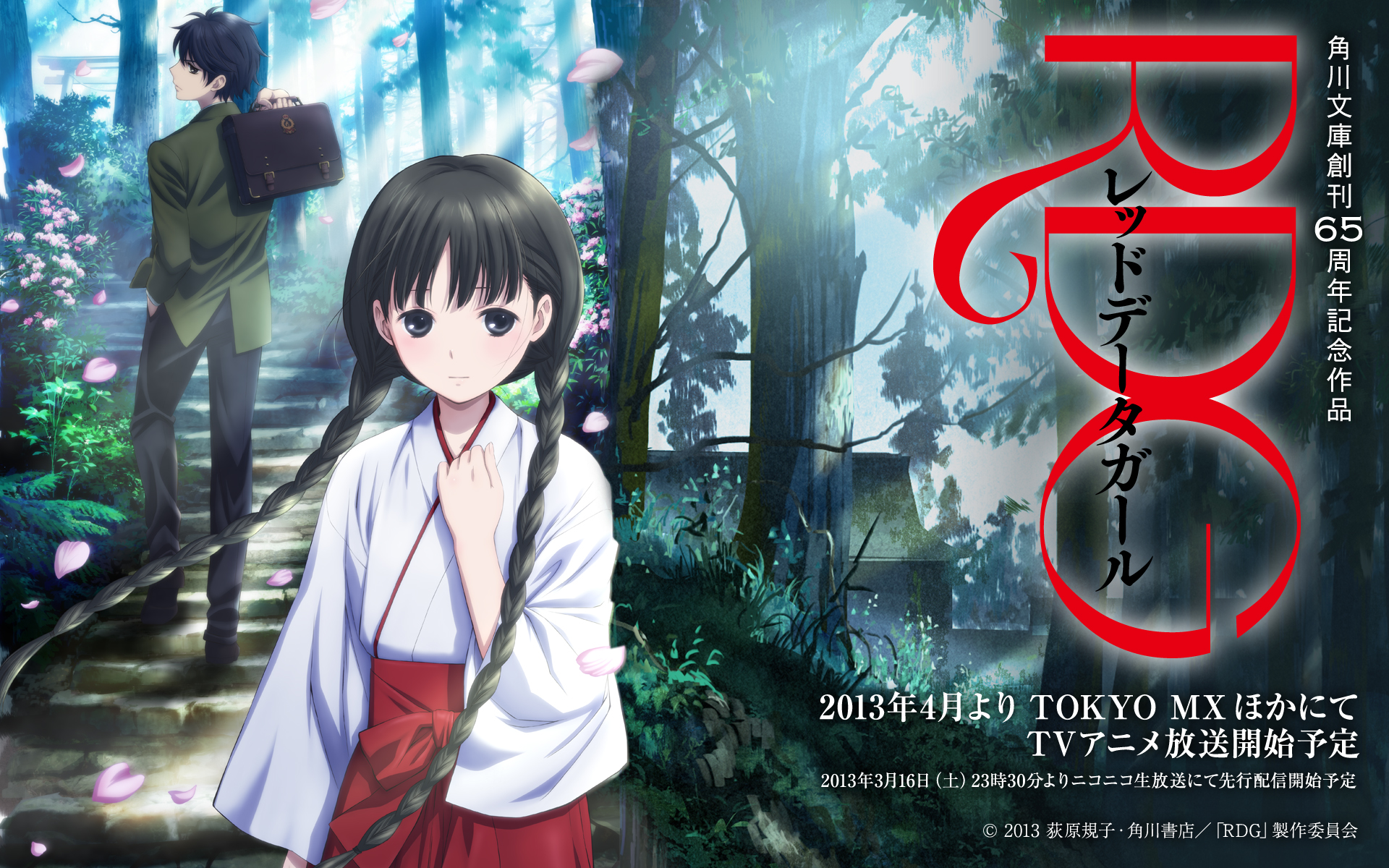
RDG: Red Data Girl

This is a short, anime, only one season of 12 episodes, but it has an interesting concept. The anime is based on a book series and a manga.

The story is about a very reserved girl who lives in a mountain shrine with her guardians and has been sheltered and protected for her entire life. She feels that there is nothing special about her, and indeed, the only thing we know about her to be different is that technology shorts out or even breaks when she touches it. She has been told however that she is a very important person, a princess, and must be protected at all costs. The story begins with her act of cutting her extremely long hair to make bangs for herself... a seeming act of rebellion as magical strength is sometimes linked to ones hair, and this act is the first step in her taking a very small step toward self actualization. Or at least affirming that she is able to do something by her own will. The next change is that an old childhood acquaintance re-enters her life, and she is told that this boy (who has never been nice to her and seems disgusted by the fact that he must do what he is told) is her servant and will be enrolling in her school to protect her.

The plot progresses, and these two interact with each other (reluctantly) and meet new people with magical ability, throughout all of which she discovers that her body is to house a very powerful spirit and grows in magical ability herself. She very slowly comes out of her shell and begins to make personal relationships, and more actively begins to interact with her magical abilities and with the spirit world.

This was an unsatisfying anime to watch. Not because it wasn't good, because it was; the characters, narrative, and take on the fantasy genre were all very compelling. It was just too short. The characters developed too slowly for the length of the show, as did the plot, and by the last episode I felt as though I was at the inciting moment of the plot... where the true story should now begin. The story ends before any of the characters resolve any personal tensions, before the relationship between the heroine and the spirit possessing her was explored and we understood the boundary between the two, or if in fact they were two people at all, and what would happen to the heroine's spirit if they aren't. We aren't even told in any great detail the significance of this 'very powerful' spirit, and the ramifications of her presence or lack there of in our world. It ended at the beginning basically. The book series might go into more detail, bu the anime is highly unsatisfying.

Not un-worth the watch though. In what they do show you, the character development is well done, and the interactions with the other world and with various magical abilities are well thought out and the basis for a very good show. If this show was one or two more seasons long, it has the potential to be one of the better animes... but it doesn't go far enough. So I would still recommend it to be watched in appreciation of the story, but prepare for the unsatisfying ending.

Sunday, 26 August 2012

Rashomon (1950)

This is a movie about a murder told from the perspectives of 4 different people set in ancient Japan. A man and a monk tell the story of a hearing to a stranger at a shrine while the three wait out a storm. During the trial, we hear the story from the perspective of a bandit, who supposedly is the murderer, a woman, who was the wife of the deceased and was raped by the bandit, and by the dead man, through a medium. Each version of the story is slightly different, but the fact that the man died, and his death in some way related to the woman's rape is present in each of the versions. At the end, one of our narrators (who is also the one who found the body) stated that he saw the whole thing and he tells us what actually happened.

The story is kind of slow-moving. There is a lot that could have been edited out and the acting was kind of overdone. The narrators were speaking of the story as a sort of lament for the state of humanity. They kept commenting on how this was such a horror story and how the state of humanity is in a really bad place if something like this could happen, and because they set it up that way, the actually story was kind of a let down. All of the characters were pathetic and I wish they'd all died... a suicide pact or something. Something to redeem their pathetic natures, but they were all simpering and childish in their own way. None of them present a proactive way to overcome their situation, they just whine and cry and it gets to be tiresome to watch after a while.


Thursday, 19 January 2012

Kaseifu no Mita

This drama was about a dysfunctional family that hires an emotionless housekeeper. Apparently the ratings were very high for this show... but I've personally seen better.

The story opens with four children and their father dealing with the death of the mother of the family. It's been a couple of weeks and the father decides to hire a maid to do the housekeeping. What with the mother gone the work around the house wasn't getting done as it used to. When the housekeeper arrives, the family is kind of taken aback by her appearance and presence. Unlike other housekeepers, she has a heavy coat and a baseball cap and she is very curt with the family, speaking without any trace of emotion. Despite this though, she was excellent at what she did, so the family decides to keep her. As the story progresses, the family learns that there is something kind of off about this housekeeper, Mita-san. One of the things is that she will do anything that is commanded of her, anything, and this of course is one of the central plot points of the story. As the plot progresses we learn more about each of the children, and their father, and of course, Mita-san plays a role in fleshing out each of these discoveries. Usually being directed to do something immoral or illegal. We also learn more about the mother's death, was it an accident? and of course about Mita-san and why she is the way she is.

All of the main characters in this story annoyed me. First off, the father and the youngest daughter look kind of weird. The father looks like a snake, literally, and it's sort of unsettling to look at him. Sometimes I find myself looking at him just to find what I don't like about his face. In addition to that his character on the show is a pathetic, spineless loser. Harsh but true. The youngest daughter doesn't look odd at first glance, but there's something weird about her teeth. They're too perfect for a kid her age. Also, she whines constantly. The oldest daughter is sort of weak-willed. There's a funny part of the show where she orders Mita to kill her, and then runs away in fear as Mita pursues her and tells her to stop. Then she orders Mita to kill her again. Its filmed like a horror scene... but it's just ridiculous. The Oldest son has huge anger issues. I can easily see his character in an abusive relationship. Never before in one drama have I been so dissatisfied with the cast.

This drama is watchable, but I was tempted to drop it half way through.


Thursday, 29 December 2011

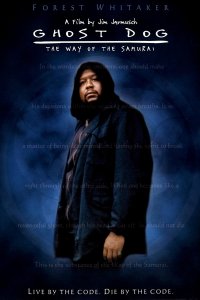
Ghost Dog: Way of the Samurai (1999)

For me, this is one of the best movies... but I wouldn't watch it more than a couple of times in my life.

It's about a man who follows a forgotten way of life in a displaced setting. The main character is a guy named Ghost Dog. He's an assassin who lives in a shack on the roof of a building. Because of past events, Ghost Dog now does work for, and pretty much serves the will of, this mob member, Louie. Near the beginning of the movie Ghost Dog is commissioned to kill a gangster in the same mob as Louie because he overstepped himself. After he killed the guy, he noticed that there was a young woman in the room who had witnessed everything, but he doesn't kill her, she gives and a book and he leaves. That young woman is unfortunately the daughter of the leader of the mob, and because of that event, he has marked Ghost Dog for death. After an indirect attack, Ghost Dog decides to go after the entire family.

Mob movies have never been my preferred genre. I'll watch them of course, but it is a rare thing for me to choose to watch one of my own volition. This movie could, I suppose, be considered a mob movie, but it is actually more about a way of life. The samurai code. Ghost Dog follows the code of the samurai and lives his life how one would assume a modern-day samurai would live it. In a way, the movie is less about the characters and plot than it is about the way of the samurai. As the movie progresses, there are quotes from a book (Hagakure) that explain Ghost Dog's actions and place them within the samurai code.

The movie can be kind of slow at times, it's more slow-paced than fast. The soundtrack can also be kind of depressing. There are a lot of dark colours and many scenes are shot at night. Because of this it's not on the top of my recommendations list. It sort of feels like only a certain kind of person would really value it, others may think it's boring, but if you are able to get into it it's a really great film. It's about tradition and honour, but told in a modern way.

The book, Hagakure: The Way of the Samurai, is also a really good book. It's not plot based, but is more a collection of philosophies and stories explaining the samurai code. I bought it after seeing the movie and really loved it. I was obviously much younger then and it was actually this movie that inspired a short karate phase. I recommend you look for the book, whether you enjoy the film or not.


Thursday, 8 July 2010

Voices of a Distant Star (2003)

This movie was a lot more abstract than I was expecting. Its very short, only half an hour long, so the story can't be developed in any great length, but the film went ahead with the characters emotionally without giving the audience some kind of back story to help them catch up. Basically, if you want to relate to this movie you'll have to do a lot of the work yourself, which isn't necessarily a negative, but it's not what I was expecting and it wasn't done well enough to make me forget that that wasn't what I was expecting.

The story follows two high school aged sweethearts, Mikako and Noboru, who were separated at the beginning of high school because Mikako accepts a mission to fly a mecha man across the solar system to fight aliens on a distant planet (which is interesteing to consider in a gender role sense because most of the time is it the guy who goes away to war or to explore and the girl stays home to wait). As she flies further and further away she tries to text Noboru and the more she travels the more years it will take to reach him. She finally reaches a faraway planet that is 8 light years away from earth and she sends a text, by the time he gets the text he's moved on with his life but they both say that they regret not having lived with each other.

I found that I couldn't really connect with the characters very well, Mikako was curled up in a ball crying all the time, even when she was fighting aliens. Noboru was distant and cool and when the time came, gave up on the supposed love of his life way too easily for the audience to believe that he cared at all in the first place. There are very few flashbacks, but the ones provided show them talking casually as friends or hanging out and were not really emotionally charged enough to set up Mikako's constant tears (which is why I said that you would have to do a lot of the emotional leg work by yourself, in your own head, because its not in the film).

Aside from the plot though, the art was beautiful. The drawing of the characters were not to my taste, but the scenery was stunning. Really beautiful artwork. I believe this was done almost wholly by one artist, which is amazing.

Tuesday, 13 April 2010

Ringing Bell (1978)

I came across this short but powerful film after watching the movie sea prince and fire child

***Spoilers below***

The story is about a young lamb named Chirin who lived with his mother and their herd in a meadow. Chirin was more energetic than all the other lambs put together and wore a bell around his neck so that his mother could find him if he wandered too far while playing. All is good in Chirin's life until one night when the wolf king comes down from his mountain and attacks the sheep in their little hut. He starts attacking one or two of the sheep and then sees Chirin and charges for him, but before the wolf can eat him, Chirin's mother throws herself on Chirin and sacrifices herself for her baby. When Chirin is able to struggle out from under his mother the wolf has gone and he finds that his mother is dead, so he leaves the meadow to find the wolf on the mountain and get revenge. When he climbs the mountain and finds the wolf he tries charging him, yelling that he killed his mother, but the wolf doesn't give him the time of day and flicks him down the side of a small drop with his tail, knocking Chirin out. When he wakes up he goes again to find the wolf, but this time tells the wolf that he wants to be his apprentice. sheep are weak and they hide instead of fighting, but wolves are strong. The wolf laughs him off and Chirin goes off to prove himself as a wolf by trying to scare buffalo, a skunk, and a couple of ground hogs or something, but instead of scaring them they just laugh and end up pushing him around instead. Chirin returns to the wolf defeated and then decides to follow the wolf around. The wolf ends up giving in and trains Chirin to live the hard and lonely life of a wolf. After much time has past and Chirin has grown into an adult ram, the wolf decides it is time to attack the sheep in the meadow again, this time with Chirin. Chirin barges into the little shack and the sheep are scrambling around everywhere to hide. One little lamb calls for his mother and she runs to him and shields him with her body, like Chirin's mother did so long ago. This strikes a chord in him and he runs out of the hut. The wolf comes to meet him and tells him not to run away. Chirin doesn't want to wolf to kill anymore sheep so he and the wolf fight and chirin ends up killing him. Then Chirin leaves, more alone and heartsick than ever before, never to be seen or heard from again.

***End spoilers***

This movie touched a chord in me, I think it would in almost anyone. When you first start watching it it seems like it will be a really fluffy vacuous movie that you'll forget 10 minutes after watching it. Instead, it's almost a testament to those who have loved and lost and then let the pain of that loss lead them down a darker road. I know that it doesn't seem like a movie for children, but I think that the way this was handled is appropriate for a children's film. There is no blood or gore, it just deals with serious issues instead of happily ever afters and the vacuous fluff we've become used to. This was made in the 70's so what's deemed appropriate now and what was then has obviously changed, but I think that films like this should be seen by children. Life is not always going to be happy, not everyone you meet will be happy, and sometimes you will be in bad situations.

The character in this film makes a choice to isolate himself and to be mean, like the wolf who killed his mom, but the way the movie ends leaves the viewer feeling his sadness and his dissatisfaction with his own life. It doesn't tell the child what should be done in a sad situation, but lets the viewer make their own decision. I actually loved it when I first saw it (as an adult) because it didn't have that happy, Disney ending. I mean I love happy endings, but our society has really sucked everything out of the 'happily ever after' idea, so much so that a happy ending seems almost false or staged in film. In almost every film you know that the characters will all be happy at the end of the movie, even if they don't end up getting the guy/girl, they are happy with their lives. This often leads to young kids who grow up having to find out that life isn't a happily ever after. There will be bad things that happen and you won't always get the guy/ girl. In fact, romance may not even be the focal point of your happiness, shocking an idea as that is. This movie had an unsatisfied character and left the viewer with something to think about. Chirin's struggle will stay with you after the credits. It definitely leaves an impression on the viewer. Now, whether or not you want to expose your child to the fact that everything is not happy in the world and that the choices you make will effect you in some way or another is up to the parent, but this is definitely a children's film. It's deeper than it seems on the surface and gives a child something to think about. Great film.


Tuesday, 27 October 2009

The Girl Who Leapt Through Time (2006)

I saw this film recommended on a forum I occasionally visit, and while I don't usually run off to watch everything recommended to me, the title sounded interesting so I decided to give it a go. Aand I'm glad I did. The story starts off rather slowly and sets itself up like a lot of other high school romance/ slice of life animes, but it slowly progressed into a sort of sci-fi romance, which was really touching. 

The story follows a girl names Makoto who likes spending time with her two best friends, Kosuke, a serious, reserved sort of guy, and Chiaki, a fun-loving joker. Though the three of them have not always been best friends, we can see that they are very close and enjoy spending a lot of time together. The point at which the story takes a more sci-fi approach is on the day Makoto is late for school. She is late more often than not, but on this specific day as she is hurdling down a hill, a train happens to be passing by at the bottom of said hill and she is going to fast to stop. She tries to slow down, but ends up hitting the barrier between the pedestrians and the train tracks and sends herself flying in the way of the train. Just before she is squashed and our story is ended however, time stops and she finds herself transported back in time, and is safe from the squishing. She has some fun with this, though doesn't yet know the significance. Around this time she discovers that one of her friends is developing feelings for her, and because she doesn't wish to change their relationship yet, uses the 'time machine' to avoid his asking her out. At the end she is forced to choose between love and friendship, but not in the way you'd think. The ending is something of a surprise (you can kind of guess what'll happen if you pay attention to the clues), but the events that take place and the choices she makes leave you with a bittersweet feeling that makes the film worth the watch.

For those who have watched the ending, it would be an interesting argument to decide whether the love interest was truly in love or whether he just wanted to preserve a certain object... The aunt's story happens to suspiciously parallel Makoto's, but it was an enjoyable movie in any case.


Monday, 5 October 2009

Princess Mononoke (2001)

This movie is a classic. The animation is spectacular and the story very well done. I happen to be somewhat into Japanese culture as of present, but before I was so into it, and people who I know now who are not into it, sometimes Japanese media goes over their heads. The cultures are kind of different and place importance on different things and when a person used to seeing one kind of story or moral repeated over and over in different ways sees something else... well they may not immediately appreciate it (an example of this would be how at the end he doesn't end up with the girl). This happens in almost every western movie because we are very focused on the 'happy ending' fairytale, validating the storyline with the 'kiss at the end', but that doesn't happen in all cultures). However, I found Princess Mononoke to somewhat transcend this confusion, because the story is so relatable and well told. I found it to be so when I first watched it, which would be late elementary school, and feel this way even more now.

The story can be translated in many ways, but the general message I got out of it was the modern attempting to erase tradition. The people of Iron Town worked hard to destroy the forest because by doing so they could earn a living in the new world making iron. The only way they could do this however was to cut down the forests, which meant that they would have to kill the gods from the old world, who were already dying out. The thing is that the Lady Osono is painted in something of a bad light as she is cutting down the forest and killing the gods, but she is an amazingly strong humanist. She's a proactive woman in a time and place where women weren't liable to have that status (the status might help to paint her as a 'bad guy' however, because even though we are making progressions, many people are still very sexist... I would bet you that if not you yourself, someone you know thinks that women are by nature evil or devious... in 2008). So when looking at it in this light Osono is opting for humanity. She takes in lepers, she saves brothel workers from whatever fate they would face in brothels, etc. and yet she's the 'bad guy'. Interesting to note at any rate.

Ashitaka is a great protagonist. A pacifist to the end. He goes on his journey to find something to remove his curse. Not for selfish reasons I don't think, but to right the wrong. He's a pretty selfless person. At the beginning of the movie, the reason he got the curse was because his sister was in the way of the cursed boar, so he had to shoot it, but before that he was trying to talk to it and calm it's anger. This is basically how he acts throughout the movie. He tries to get things done without violence, but if it comes to it, he will resort to violence to protect himself or those he cares about.

I didn't really notice the environmental message when I first saw it. I was more focused on cultural loss. But recently, with the environmental bludgeon the media has been playing around with, I noticed just how 'for nature' this movie was. Traditionalism would of course take the stance against industry which would be a way to save the forest, so it makes sense, but I guess I just went into it too symbolically. It does have a pleasant environmental message however, better than a lot of other animated environmental movies.

So, to sum up, this is a great movie.


Tuesday, 1 September 2009

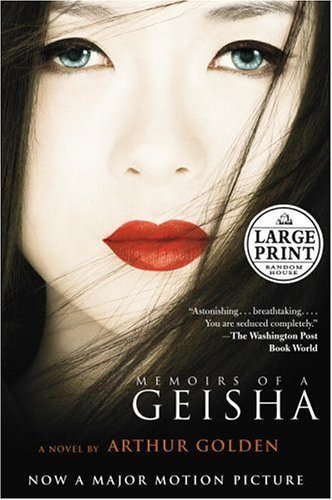
Memoirs of a Geisha by Arthur Golden

This book was very detailed. I read it after watching the movie, and learned more in the first few pages than I did from the entire film. This is a story about the life of a geisha and the complexities and potential heartbreak and constrictions that come with that distinction. We watch as a girl is first sold to a geisha house by her parents, and slowly molded into a geisha. The girl falls in love with a man, a much older man, and we witness her pain of not being able to be with him because of what she is.

I thought that though the author was very descriptive, but I wasn't compelled to immerse myself in the book. Sometimes I felt the author's writing style to be uncomfortably detailed. I do enjoy detailed writing, and... I don't know what it was but at some points I just felt uncomfortable. Maybe that was the author doing his job well, as I know that if I lived in japan at that time and was in that situation I'd be pretty uncomfortable, but people can write about uncomfortable subjects and not make it uncomfortable to the reader, so I guess I didn't enjoy his writing style. In fact, if I remember correctly I put this down for a while somewhere in the middle of it and then convinced myself to finish it just to be able to put it on the shelf. Of course it didn't help that I knew the basic story line from watching the movie.

The story itself was fascinating though. It covers a very interesting subject and is very much worth the read.


Thursday, 9 July 2009

Sisters Of The Sword by Maya Snow

This book was surprisingly good. I wouldn't say that I was surprised by the material, because you can get a pretty good idea of what to expect from the plot by reading the summary, kind of a Mulan/ Alanna series (Tamora Peirce) story about a girl who rises out of the stereotypical female role and sort of blurs the boundary we so readily assign to gender association. And this story is a good one, but because it's so over done there is a huge potential for failure. This book however, did not fail.
 

First off I have to say that I'm somewhat impressed. This is a story about two young girls dealing with the death of their father and brothers, and there is actually evidence of violence. It is a children's book so of course there is nothing too graphic, but it is no max and ruby! You fear for the characters and the suspense your fear creates because they could actually get hurt really increases the anticipation. The story makes you want to feel things basically :P but again, this is a novel for children. I picked it up in the 9 - 12 section of the book store and I'd say the subject matter is handled in a way appropriate for that age. More often than not, though danger is close at hand, the girls are spared what would be a scary scene (and what would have been added in the adult version of the novel with more gore and blood) leaving only a handful of actual encounters wherein they are confronted with an unpleasant confrontation.
 

The main characters Kimi and Hana were great as well. The story wasn't so much about how they 'beat the system', how they showed everyone that girls can do whatever boys can. It was a better story, side stepping that superficial attempt at feminism. It was about inner strength and fighting your own demons with what you've got. And yes, Kimi wants to be a samurai like nothing else, but the focus of the story is on how she reacts with strength and courage when such a bad thing has happened to her and her family. She uses her desire to become a samurai to move forward, to avenge her family, but her reason of existence isn't to prove that she can. She knows she can. Her purpose is acknowledge her ability, nurture it, and then use it to best accomplish what she desires.
 

The book ended... like a beginning, so I assume this is the beginning of some sort of series. And this is a novel written for children, but that I'm 20 yr old university student and still enjoyed it says something, I think, about the author's talent for storytelling. It was a well written book with a good story and great characters. I look forward to a continuation.