Showing posts with label 50's movies. Show all posts

Saturday, 19 October 2013

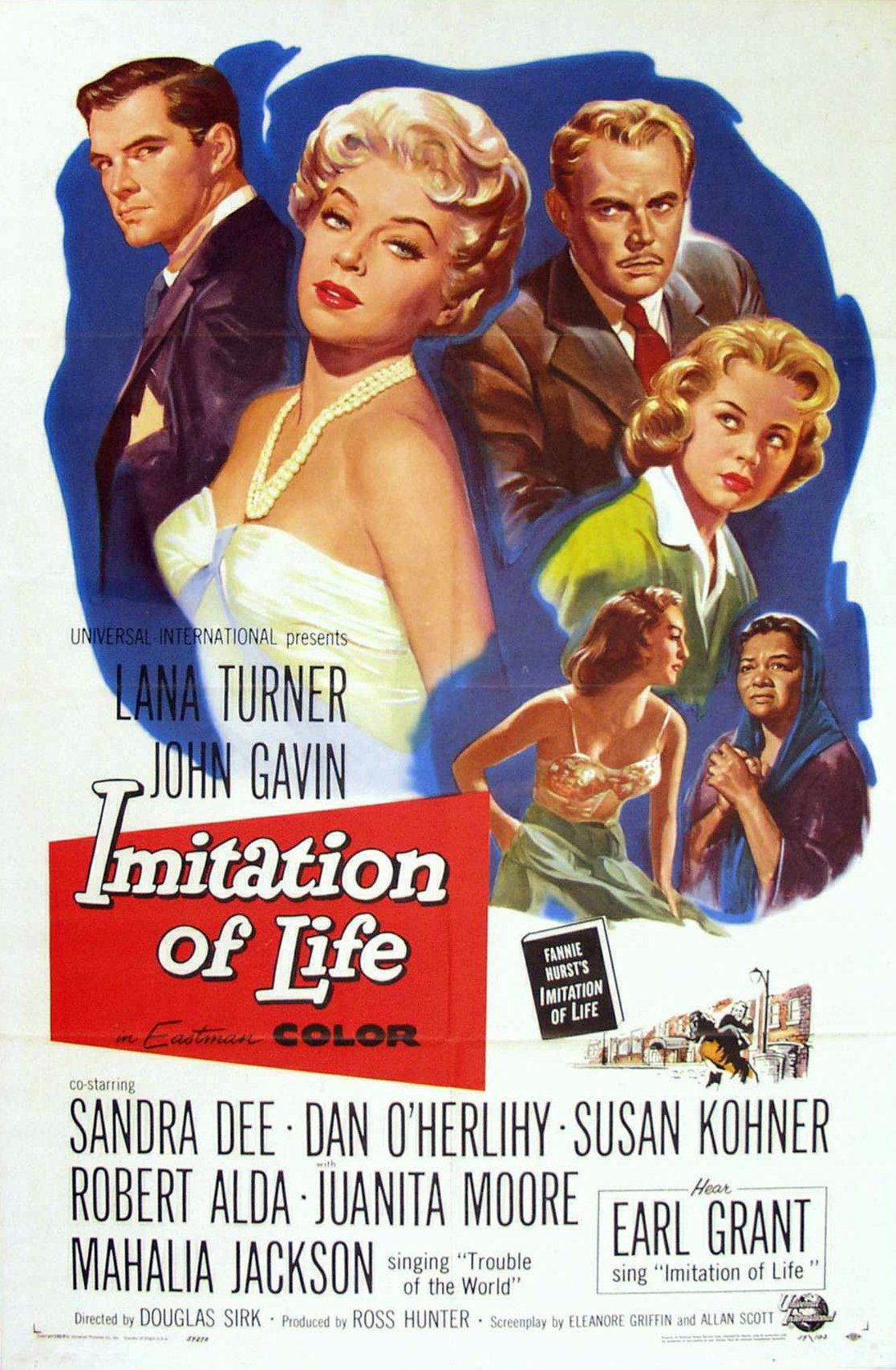
Imitation of Life (1959)

I picked up this movie on a whim thinking it might be some kind of romantic comedy or heartfelt family film... I was unprepared.

The first scene encapsulates the essence of the characters throughout the entire story. The film begins at the beach with a mother frantically searching for her daughter. A photographer (struck by her beauty) pulls her aside to settle her down and points her in the direction of the police to help her with her search. Little did she know, a matronly black woman had just reported the lost girl missing, as she has wandered over to play with her own young daughter. The frantic mother is reunited with her child and allows her to play with her new friend. She makes conversation with the black woman while the children play and asks how long she's been looking after the child shes with (as the young girl is fair-skinned, she assumed the older woman was a nanny) to which she replies that the child is her own, but her father was fair-skinned also. The women become attuned to their daughters, who are having some fun with a sleeping man and a pop can, which prompts the young photographer to snap a picture of the two. The first mother, Lora, scolds her daughter, Suzy, and says they're going home. The other mother, Annie, had previously offered her services to watch Suzy during the day, but Lora had declined saying that she couldn't afford to pay her. At thy point however, it becomes apparent that Annie and her daughter, Sarah Jane, have no place to stay and Lori takes the two of them home with her. The young photographer offers to bring the photo he had taken to their apartment later (maybe to get a second chance with Lora). This first scene introduces all of the main characters, and perfectly sets up and provides a brief caricature of each of these characters motivations and problems throughout the course of the film.

Lora is an aspiring actress who, after being widowed, moved with her young daughter to New York to make it in the industry. Throughout the majority of the film this passion will come between herself and her personal life. Her daughter Suzy is a sweet, good-hearted child and just wants her mother's love, which may be the motivation behind what develops into a crush for the young photographer, Steve, who has an undying flame for her mother.

Annie's goal in life seems to be to do whatever she can to secure a safe place for her daughter Sarah Jane to grow up in, including working for free for Lora as a live in maid and nanny. The problem is that Sarah Jane detests her negro heritage and everything that comes with it (in the 1950's). Because of her fair appearance, Sarah Jane is able to pass for a white girl and avoid racism and discrimination... That is until her well-meaning mother comes into the picture. Sarah Jane constantly renounces her black heritage and condemns her mother for existing, thereby informing the world that she is not white, but is black, and is entitled to the poor treatment of all of the other blacks. Her struggle is trying to escape a world of discrimination for a world of inherent privilege, where she doesn't have to live in back rooms and always come second to whites.  This struggle is continuously thwarted by her very black mother however, unintentionally, as she tries to love and care for her daughter.

I really enjoyed this film, much more than I initially thought I would be. I was completely drawn in and emotionally attached myself to the characters and their struggles. Lora and Annie are both such strong women who do everything in their power to improve the lives of their daughters, but ironically it is those very efforts that drive their children away from them. There is a bit of a misogynistic message by the writers, implying that a woman cannot successfully care for their children by working or leaving the house, that they should be in the home while the man works or their children might be a bit messed up, but this is the 50's. The name of the film is beautifully appropriate also, imitation of life. Both of these pairs are striving for some sort of ideal existence, but both fall short of that mark. Lora strives to be a true artist and live off of her art too, but to make it big... or at least put some food on the table, she ends up compromising some of her morals at the direction of her agent (though things never get grimy, it remains a family film). She also achieves a life of glamour and prestige, but the victory is hollow as she must sacrifice family life and romance to pursue her ambition. Also, her life as an actress adds a level of falseness to her interactions that she struggles with as her success grows. Suzy just wants her mom to be home and spend time with her, but that dream is never realized and she is left living a life without that need filled. As for Annie and Sarah Jane, they both live a sort of imitation of 'life' as black women. They will never fit into their society the way Lora and Suzy do, but the way Sarah Jane tries so hard to fake it, to... imitate the race she sees as more privileged. And Annie would just like her daughter to live a good life and take pride in who she is, but she never lets her concern show externally, presenting a contented, pleasant facade.

This was a captivating film. It was an intense drama, but it never got grimy in the character's decent into their struggles. There wasn't that feeling of 'no hope', where a character had fallen too far from where they felt they should be, where there would be little chance for redemption. Circumstances always held an aura of hope, because each character was trying so hard only to better their situation in life. There was also the theme of family connection and communion, both between mother and daughter as well as between the four women collectively. They worked together and kept together (kind of) to build themselves up from their unpleasant situations. Even in the face of one person's disaster, there was always another one of the women around to help out the person suffering, or to offer a word of consolation or demonstrate affection. There was never the impression that these women were alone and had to deal with a big, scary world by themselves and with everything working against them. Even at their individual darkest moments, there was always a shoulder to lean on and a helping hand within reach. This fact is what I think didn't make this movie as depressing as it could have been. They were a family and stuck together, especially when times got tough. It's a bit of a deviation from the 1934 version, but I would say that this one would be the one out of the two to watch, if you only have time/ inclination for one. I definitely recommend this film.


Tuesday, 31 July 2012

Seven Brides for Seven Brothers (1954)

This is a great movie about a backwoodsman named Adam who goes into town to find him a woman to cook and clean and pick up after him and six brothers. He scours the town, sizing up the women he finds, but most of them don't meet his approval. Either they're too weak, or too old, or already married, but he eventually comes across Millie, a woman who works at inn, and she's out back chopping wood. After taking a look at her apparent durability and tasting her cooking, he asks her to marry him... but nothing flowery here, he straight out asks her if she wants to come out with him to live on his farm. He then practically explains to her that he would have properly wooed her, if there had been enough time, but he just didn't have the time. Millie is kind of taken with Adam however and looks right past his rough frankness, thinking that he's quite taken with her. She's also not very happy with her life at the inn, having the feed and pick up after a small army everyday. When she's taken home however, she finds out that's exactly what she signed on for. She's upset at first, but she really takes the boys to her heart and starts preparing them to find girls of their own... and as they're all rough backwoodsmen who've never been in a lady's presence for longer than a second, she has to teach them some manners. The boy's make an impression on several girls in town, but things don't go as planned and they all end up back on the farm with only themselves for company. Now that they've discovered love though, they're all miserable, and Adam is worried he'll lose them all. He hatches a plot to kidnap their lovers, but when he carries it out and brings them unwillingly back home, Millie is so furious that she kicks the men out of the house for the winter (as the pass back to the village is of course snowed in). Adam is miffed at Millie's anger and decides to hide away in some forest cabin for the winter, leaving the boys to fetch and carry for the girls, without actually being able to interact with any of them. As spring comes around, the girls seem to have more than forgiven the boys, and Millie seems to be pregnant. Will the boys and girls be able to be together when the girl's fathers catch up with them? And will Adam ever value Millie as his brothers seem to value their ladies? Watch the find out!!!

I love this movie. The plot and the songs might sound a little but chauvinistic, and it is, but unlike many films of the time, this chauvinism is contested. In fact the way Adam acts toward Millie is almost satirically overplayed as we watch and listen to him size up women to be his wife/ maid, as we hear him convince his brothers that it is ok to kidnap the girls by telling them about the rape of the sabine women, etc. Don't get me wrong, this was a reality in the past. This exact situation actually happened with members of my own family... and they actually had six other siblings, though one was female. The way Seven Brides presents the 'man first' attitude is to have it noticeably present, and have Millie noticeably resist it. Also, the brothers are all sweetly infatuated with their sweethearts of choice, and At the end, Adam and Millie's situation also takes a turn toward the better nearing the end of the story. To top it all off, the songs are great, and it's a musical about freaking lumberjacks! How often do you come across that!? It's a combination of  one of the most 'girly' interests- musicals, and one of the most masculine personalities- lumberjacks/ backwoodsmen. If you like musicals, love stories, pioneering times, comedies, barn yard brawls, or just good film, this is a definite must watch.


Saturday, 21 January 2012

Cat On A Hot Tin Roof (1958)

This is the story of an unhappy couple who are called back to the husband's childhood home, a wealthy estate in the south, because his father is not expected to live much longer. We learn very quickly that the couple, Maggie and Brick, are not getting along and have in fact been fighting for some time. From their interactions we get the sense that Maggie has done something in the past that is so unspeakably despicable in the past that she is lucky to still be with him at all. She comes off as a potentially sensual woman, but acts only with contrite concern for her husband. She loves him dearly and seems to want nothing else save his love in return.

As if their private situation isn't enough, they must also deal with the other people in the house. Brick's brother and sister-in-law are vicious people who are only there for the family fortune, and Brick isn't exactly on speaking terms with his parents. Maggie must deal with a conniving sister-in-law, who is constantly reminding her that while she and her husband have managed to have many children, she and brick have none. Her mother-in-law also seems concerned that they are without child. What lie in Maggie and Brick's past that keep them at arm's length? And what will happen to that family fortune? Or the family it belongs to?!

This isn't my favourite Elizabeth Taylor movie, but it's pretty good. Maggie was an interesting character. Strong, but quietly so. She was independent, but desired dependency, and though I'm sure she could have played the same games as her sister-in-law, she seemed to exist on another level entirely. And on the subject of Brick, who has an issue with not only Maggie, but his father as well, he's just a drunken, immature, lay about. His father is somewhat forceful in his dealings with him, but Maggie is completely willing to meet him half way, and go further than that just to make up with him. Despite how she is with him, he just completely shuts her out, not even in company. When I did find out what was between them he seemed even more immature than his behaviour lead me to believe, and if I were Maggie I wouldn't be that forgiving. Overall it's a good movie though.

Friday, 2 December 2011

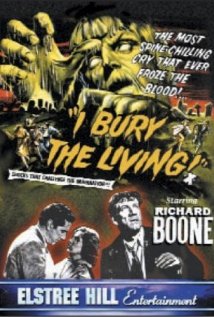
I Bury The Living (1958)

This story is about a man named Bob Kraft who takes care of the business at a cemetery, the cemetery chairman. It's his job to manage the burial plots and to do all of the paperwork when someone dies. To keep track of all of the purchased graves, he keeps a big map of the cemetery in his office with little pins sticking out of all of the graves. The white pins represent purchased graves of living people, and black pins represent the graves of dead people.

The day after a young married couple comes into to buy a pair of graves for themselves, the die. When Bob goes to change their white pins to black ones, he finds that the pins are already black. He gets a sort of eerie feeling, like he marked them for death. To make sure it was just a coincidence, he switches a white pin for a black pin on the map. The next day the person whose pin he switched also died. He then starts getting worried and suspects that there's something suspicious about the map and tries to tell someone about it. Of course no one believes him. The police officer and reporter laugh off his worries and the former chairman, his uncle, just thinks he's been working too hard and asks him to switch more pins to make him see that he's imagining everything. Of course the following day, the people whose pins were switched die of unknown causes. Is Bob really responsible for these deaths? And if so is there anything he can do about it?

This film was really well done. The plot was decent and the acting was phenomenal. As it is with some of these older suspense/ thrillers, there is a wonderful sort of realization of horror undertaken by the characters that isn't so common in modern film. A slow dawning of the fact that there is something truly horrible happening, and there's nothing he or she can do about it. Worse, they might even be the cause. Even though the plot sounds kind of flimsy at the outset, they really do a great job at making it come to life.