Saturday, 5 November 2011

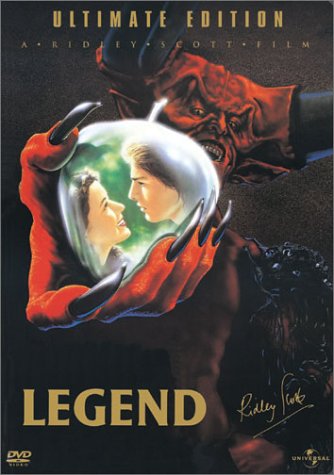
Legend (1985)

This film is about a dark lord who wants to destroy all that is good in the world and take over it, so sends his minions to kill the only thing that could stand in his way, the personification of light and purity, which happens to be unicorns. At the same time, a princess named Lily and a feral child named Jack meet up in the forest. They’re in love and Jack decides to show Lily the unicorns as a present of sorts, and the dark lord’s minions follow them in the shadows. When they meet the unicorns the goblins shoot a dart into one of the unicorns, scaring them away, and then steals the male’s horn. The female unicorn and princess Lily are also eventually captured and taken to the dark lord’s lair, and at this point it is up to Jack and the forest faeries to save the unicorns and the princess.

I only heard about this movie a couple of months ago and after I watched it, I wondered why. It’s on the same level as The Princess Bride and The Neverending Story, but I suppose it wasn’t a book first. I was kind of skeptical when I first picked it up because Tom cruise is Jack. He was never one of my favourite actors, and he I wouldn’t peg him as being able to pull off a fantasy film… but he’s actually pretty good. Also, Tim Curry is the Dark Lord. Enough said.

I suppose the thing that would turn most people off about the movie would be the fact that there are unicorns in the movie, and I guess I can understand why that may put some people off. It’s very rare that you’ll find a serious, adult movie with a unicorn in it. Unicorns are almost synonymous with little girls and tea parties, and any attempts at showing their heroism or prowess are often side-lined, if at all existent, at least in pop culture. I promise you though, you will not think that this is a movie for children and may even find that you have a soft spot for our horned friends, not that they have a lot of screen time. In addition to a non-childish representation of unicorns, I also enjoyed the other faeries in the movie. As is so often stressed in faerie lore, the use of riddles and a battle of wits saves Jack many a time when he’s dealing with these inhuman friends and foes. I think you have to watch the Director’s cut (or the Goldman version) though, because the other version cuts out some of that banter.

One of the things I didn’t like so much was how the fall of the unicorn was sort of blamed on Lily. She went to go touch the unicorn despite Jack telling her not to, and when she touched it the goblin shot his dart. After that she was more or less blamed for goblins taking the horn. This doesn’t really sit well with me. I don’t know a lot of unicorn lore, but I know that girls are supposedly the only humans unicorns can really stand, so why would a girl touching a unicorn be a bad thing? It wasn’t her touch that cursed humanity, it was the goblins. Unless she was somehow meant to personify the dark lord and his evil, but that might be getting a little too biblical in its blame.

Something interesting about this movie is that, according to my Legend of Zelda friend, this film is the basis for the video game ‘The Legend of Zelda’. Wikipedia says that the inspiration for the game came from the creator’s “explorations as a young boy in the hillsides surrounding his childhood home in Sonobe, Japan where he ventured into forests with secluded lakes, caves, and rural villages.” I don’t know whether or not Wikipedia is right (you never do) but I do know for a fact that this exact explanation is how Miyamoto (the creator) came up with the idea for Super Mario Bros. … so maybe they’re just copy and pasting. Plus, Zelda was released in 1986 while Legend came out in ’85. You do the math.  Knowing this you’ll be able to pick out the similarities very easily, if you know anything about Zelda that is.

Sunday, 24 July 2011

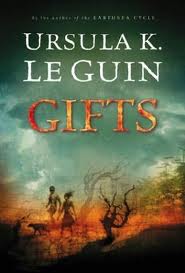
Gifts by Ursula LeGuin

This is the first book of three in a series called The Annals of the Western Shore. The story takes place in a world where magic exists, but only to those who live in the northern territory called the Uplands. To those who live elsewhere, magic is little more than bumpkin superstition. Magic isn't as we traditionally know it in fantastical literature either. In the Uplands, a person is limited to a certain ability they inherit from their ancestors, and the strength of the ability depends on the purity of the bloodline, amongst other things. These abilities are called gifts.

The story is about a boy named Orrec. We begin by learning that Orrec is blindfolded because of the strength of his gift. His is the gift of unmaking, which basically means he has the power to destroy anything he looks at if he wishes it. Orrec's gift was too powerful however and he had no control over it, which is why his father blinded him. The plot basically leads up the that first scene and paints Orrec's life and his struggles with this gift.

More than a fantasy, this is a coming of age story. Orrec is given a powerful 'gift' but has absolutely no control over it, making himself a deadly threat as a result. He tries to match himself to historical figures and satisfy his father's wishes, but no matter how hard he tries, or how seemingly powerful his gift may be, he feels weak and powerless and completely out-of-place. His gift is ironically more of a burden. It's only when he realizes that he must take his power into his own hands and makes it what he wants to be that it truly becomes a gift. We all have 'gifts' or abilities or skills, and they can either be a burden or they can enrich your life. This is the story of Orrec's journey learning how to make his gift be a gift.

Sunday, 3 July 2011

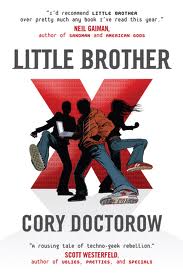
Little Brother by Cory Doctorow

As one can gather from the title, this book is almost a response or a re-imagining of George Orwell's book 1984, one of the most terrifying portraits of society's potential in print. Big Brother is the term in that book for government surveillance. Little brother, then, is an individual's response to his government's intrusion into his privacy and  his creation of a grassroots revolution for freedom.

The main character is a high school student named Marcus. He is an average kid in every respect, save his impressive technological knowledge, and his use of that knowledge to rebel against the systems put in place at his school. He also sometimes plays hooky with friends to play a game. However, things change forever when a bomb goes off in the city in what is assumed to be a terrorist attack. Marcus and his friends get abducted by a branch of the government called National Home Security (NHS) and is interrogated and abused by them and is finally set free, along with all of his other friends except one, who was injured before the abduction. Marcus then takes it upon himself to create an underground network free from the government's surveillance where he becomes a kind of cyber Che Guevara. He begins setting up little things to hinder the NHS, kind of like how he messed with his teachers, but on a much larger scale. As things get more and more intense Marcus finds himself facing an increasingly dangerous reality. He must figure a way to save his country from becoming a police state while still keeping his own freedom and anonymity in tact.

This was a really well thought out book. The author put together a very clever story line with a very active and intelligent protagonist. He puts together situations that seem hopeless and daunting, but then has his characters come up with something to react in a positive way. There is also a lot of  information in the book. Some it technological, some is historical, some literature based. You're likely to learn a little bit reading this book. I love books like this because they inspire learning to go beyond the story and demonstrates how great getting to know more about something can be. In short, this is a very important novel for young people. It is an introduction to the dystopian novel, but with more hope and less futility. It may also inspire the reader to question some of the events or laws going on in their area. It forces you to think, but it's fun and fresh at the same time. In addition, the fact that both Neil Gaiman and Scott Westerfeld are speaking in favour of it was all the propaganda I needed to pick up the book, and they were right.

Sunday, 26 June 2011

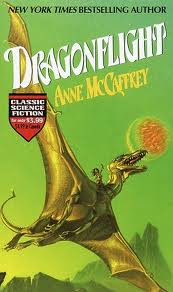
Dragonflight by Anne McCaffery

Dragonflight is the first in a long series of books taking place in McCaffery's land of Pern, a land of dragons and dragon riders. What's interesting about this book is that it's actually a science fiction, not a fantasy. One would think what with the dragons and all that this would be a fantasy story, but alas, the dragons are just a facade for the underlying science fiction plot.

Pern is a land inhabited by humans. Unfortunately, a planet close to Pern gives off deadly spores every couple of years called 'Thread' and these spores fall down onto Pern and destroy everything they come into contact with. Some humans have learned to tame and form a psychic bond with dragons, these people are called dragon riders. It is the dragon riders and their dragons who battle the thread attacks and keep Pern safe from the threat. There have not been any signs of thread for hundreds of years however, and dragon riders have become an anachronism.

The story begins with two prominent dragon riders searching Holds, or different settlements, for young women. A queen egg has been laid and a new Weyrwoman, the female leader of the dragons, must be found to bong with the new queen dragon. They eventually find a young woman pretending to be an old drudge named Lessa, and after dealing the fascist invader controlling their land, the pair take Lessa to their Weyr, the place dragons and dragon riders live. She of course impresses the new dragon queen and so the story begins.

The author paints Lessa as a strong sort of heroine, but in my opinion she spent more time whining and being loudly indignant, which may be considered strength to some, than actually displaying any real strength of character. Her relationship with F'lar, her love interest, was more like that of a defiant child and her disciplinarian. I know this is aimed at teens and they're supposed to be all angsty and everything, but why does romance have to be about a woman defying a man's power over her? There were some other misogynistic messages in the book besides the romance roles which were also somewhat tedious to read through. Then again this was published in the late 60's and that might have been a more popular topic at the time and more widely accepted, or even revolutionary. Remember, this is a science fiction after all. F'lar also displays an exaggerated machismo that almost seems too pig headed to be taken seriously at times. His relationship with Lessa is borderline abusive, which can sometimes be mistaken for romance in romance books directed towards women for some reason. Maybe because of the adrenaline rush caused by the fear that that could happen to you. I really don't know. But there is a lot of yelling and shaking on his part whenever he deals with Lessa as he tried to subdue her. Just something to watch out for.

*Spoiler* If you have yet to read the book don't read this because it will lessen the experience for you. I do have an issue with the time travel aspect of the plot. I like the idea and it was an ingenious plot twist... but the way the author went about incorporating it into the plot doesn't really make sense. Lessa goes back in time to ensure that certain events take place and that just doesn't sit right with me. The idea of traveling back in time goes as follows; a person travels to a point in time that has already occurred. Pretty simple on the surface. The problem in mcCaffery's case is that the past in her story is based on the fact that Lessa discovered that she was supposed to go back in time and change things. So there is no original history that Lessa goes back to change. She gives herself clues in the past that tell her she has to go back in time, which the people there follow because she tells them about the future. The idea of her going back in time might be able to work out... except that the reason she decides to go back isn't because of an organic idea she had based on her evaluating the present and deciding that to save the present she must go back, she comes to the decision to go back in time because of a clue she leaves herself. Even this would be alright if an original, untouched-by-time-travel history is presented, but there isn't one. Despite this flaw I did enjoy the idea, and if it was worked out a bit better it would have been really cool. It was good regardless, but I enjoyed it less because it was illogical. *Spoiler*

Aside from the characters, the plot was actually really well done. It was fast paced, but the author took the time to set up a nice flow. It is definitely a page turner. If you are a fan of fantasy or of dragon lore you will probably enjoy the world McCaffery has created here. It is filled with McCaffery's own lore, which is quite interesting. And if you are a sci fi fan, well there's some time travel in there as well as a bit of outer-worldly threat. Despite it's faults I suggest you pick up this book and give it a go. Aside from the fact that it's a decent read, it's been around long enough to have influenced a lot of today's fantasy/ sci fi writers. Though a bit dry at times, it's a quick read worth the time invested.

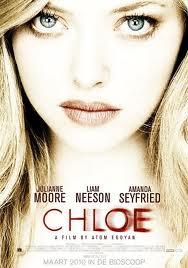
Chloe (2009)

Chloe is a psychological thriller about a middle-aged woman who suspects her very flirtatious husband of cheating on her. After her husband missed the surprise birthday party she'd planned for him, the couple go out with some friends and she ends up meeting an escort in the bathroom. She then hires this escort, Chloe, to tempt her husband to see how he will react. Chloe then reports back to her with the various events that occur.

This movie had the potential to be very good, but didn't quite hit the mark. There are some great actors in the cast and they play their roles very well, the atmosphere was also pretty spot on. The problem is actually with the plot. The movie spends far too much time setting up the story and characters and building the overall plot, which is fine and is expected in movies of this genre... so long as all of that building sets up the audience for some sort of logical catharsis. But that's not the case with this movie. The climactic 'twist' came a little bit out of left field. When it was tied in to previous events in the plot, the resulting dilemma seemed too passionate and emotionally charged for the events that it supposedly stemmed from. So much time was spent building the story and the suspense, but at the same time.. not enough time and effort went into explaining Chloe's motivation and perspective, which made the whole film fall short of actually being good. It wasn't a bad film by any means, but it will disappoint you on an intellectual level.


Tuesday, 31 May 2011

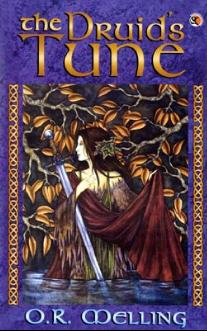
The Druid's Tune by O.R. Melling

The Druid's Tune is by the author of the somewhat well-known series called The Chronicles of Faerie (which are a superb read, aged late elementary school/ early high school, but is really fun for all ages).

This story features a young brother and sister, Jimmy and Rosemary, who are sent to live with their aunt and uncle in Ireland for the summer. While neither are too pleased to be sent away from their friends on their break from school, they decide to try to make the best of what seems to surely be a boring couple of weeks on a farm in some small Irish backwater town. When they arrive they find a very kind and friendly aunt and uncle awaiting the pair at the farm, as well as a strange farm hand hired by their uncle. They sneak out one night, see this farm hand walking toward the small lake near their uncle's property, and decide to follow him. The man begins singing and the two children are knocked unconscious. As it happens, that man was a druid, and by his power they've been transported back in time or between universes to the infamous Queen Maeve's army as she and her men are undertaking The Cattle Raid of Cooley. Along with this figure, Jimmy and Rosemary also meet up with the hero CĂșchulainn, the hound of Ulster. Through various bouts of time/ space travel these two bear witness to one of the most well-known epics in Irish folklore, and do their part to help out where they can.

This book was a great read, not only because the character's and plot had some substance, but because it is one of those books that will get kids interested in history and folklore. This story is taken right out of Celtic mythology, The Cattle Raid of Cooley or the Tain Bo Cuailnge is one of the national epic myths in the Irish tradition. If you are unfamiliar, it is on the same scale as The Odyssey or The Aeneid; CĂșchulainn would be like an Achilles, the guy Brad Pitt played in Troy. Irish epics aren't as well known as Grecian/ Roman/ English epics, but are just as good, and books like this one will inspire young people, and old people, to look up some of those old stories and educate themselves about times past and people gone.

Aside from inspiring some self-educating, the book was actually a decent read. I was a little bit worried when I figured out that they were going to relive this tale because I didn't want the author to ride on the coattails of the epic and just have some modern-day kids there to put in some wise crack remarks to keep the audience semi interested. Thankfully Melling is a talented author and our protagonists can stand on their own two feet. We actually learn little more than the basics about the myth itself because the author is too busy developing characters and relationships to fill the reader in on a presumably missing literature lesson. Rosemary and Jimmy are both good characters. Gutsy and head-strong, but full of heart. The only issue I'd have is how little trouble the pair had in adjusting to life in the bronze age. The druid is also an interesting character as he seems to be trying to find himself, or enlightenment, for the entire story.

Melling has a talent for inspiring an interest in Celtic myth and legend, in all of her books, not just this one. I suggest you try to read as many as you can get a hold of.

http://www.ormelling.com/index.html

Friday, 13 May 2011

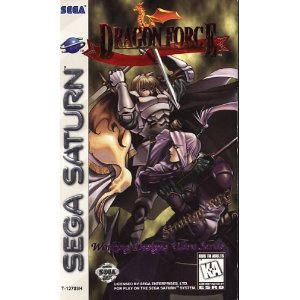
Dragon Force

I loved this game growing up. It's an amazing strategy game with just enough of a story line to not make it all about telling soldiers where to go. It's not very plot based at all which is great, you can really do whatever you want, but there is enough structure to give the player an objective.

There are 8 characters in total, each is a monarch and a master of one of the different types of soldiers you can use in the game. The objective is to pick one of the characters and conquer the whole world. You have a limited number of troops and you have to decide where you will send them, and what kind of soldiers you will send where. Each class has an opposing class that they have an advantage over, and one that has an advantage over them. When you choose a character to send into battle you have to take into consideration how their class will fare against your opponent.

When you first play the game you can only choose 6 of the 8 characters, but after you beat the game once you can unlock the other two characters to select them. Each monarch is different and so every time you play you'll have different strengths and weaknesses which will probably keep you entertained for a good while. Even after beating the game with all 8 characters, I sometimes went back to replay it, it's really that good. You can change your strategy every time you play too... it's a really versatile game.

As a player you do not actually fight with any of your characters. You just play the role of an overseeing general. You tell who to go where and give the commands in battle, but you never actually bloody your own hands. It's more of a thinking game then a first person combat game.

It's amazing and I recommend you try getting your hands on it, or playing it at least once if you can.