Showing posts with label dystopian. Show all posts

Sunday, 3 July 2011

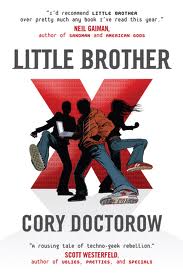
Little Brother by Cory Doctorow

As one can gather from the title, this book is almost a response or a re-imagining of George Orwell's book 1984, one of the most terrifying portraits of society's potential in print. Big Brother is the term in that book for government surveillance. Little brother, then, is an individual's response to his government's intrusion into his privacy and  his creation of a grassroots revolution for freedom.

The main character is a high school student named Marcus. He is an average kid in every respect, save his impressive technological knowledge, and his use of that knowledge to rebel against the systems put in place at his school. He also sometimes plays hooky with friends to play a game. However, things change forever when a bomb goes off in the city in what is assumed to be a terrorist attack. Marcus and his friends get abducted by a branch of the government called National Home Security (NHS) and is interrogated and abused by them and is finally set free, along with all of his other friends except one, who was injured before the abduction. Marcus then takes it upon himself to create an underground network free from the government's surveillance where he becomes a kind of cyber Che Guevara. He begins setting up little things to hinder the NHS, kind of like how he messed with his teachers, but on a much larger scale. As things get more and more intense Marcus finds himself facing an increasingly dangerous reality. He must figure a way to save his country from becoming a police state while still keeping his own freedom and anonymity in tact.

This was a really well thought out book. The author put together a very clever story line with a very active and intelligent protagonist. He puts together situations that seem hopeless and daunting, but then has his characters come up with something to react in a positive way. There is also a lot of  information in the book. Some it technological, some is historical, some literature based. You're likely to learn a little bit reading this book. I love books like this because they inspire learning to go beyond the story and demonstrates how great getting to know more about something can be. In short, this is a very important novel for young people. It is an introduction to the dystopian novel, but with more hope and less futility. It may also inspire the reader to question some of the events or laws going on in their area. It forces you to think, but it's fun and fresh at the same time. In addition, the fact that both Neil Gaiman and Scott Westerfeld are speaking in favour of it was all the propaganda I needed to pick up the book, and they were right.
Tuesday, 1 September 2009

Fight Club by Chuck Palahniuk

This is an amazing book. If you've seen the movie there won't be any surprises, but the book goes more in depth into the concepts and such so the reader can get a firmer grasp on the ideas the author is trying to convey.

The story starts off with this guy who's going to these anonymous groups for people with terminal diseases, but he doesn't have a terminal disease. So right at the beginning of the book we have the main character searching out destruction as a way to solve his discontent. The cause of his discontent of course would be that he feels he doesn't belong within his own society, that his individual self has no presence when interacting with society as a whole. So the individual revolts against society, reasserting its authority over itself. And this would be the reason for fight club. what makes fight club so wonderfully appropriate as a beacon for the individual to rise up against society is that society finds the concept of fight club so abhorrent, it doesn't understand the logic. Society's morality dictates that we are all special individuals that are to cherished. We are all special individuals... something of an paradox, but as we all sway to society's rhythm we can see the logic. But if we take this statement apart and apply it to our own lives, because the western world believes this to be true, generation me as an example, and yet we are all alienated and desire/ are forced to be the same. One of the mantra's in this book was 'i am not a special snow flake' or something to that effect. By denying society's morality, the individual recognizes their discontent and counters it (of course in real life the contrasting extreme is no better than what caused the trouble in the first place, but one very much deserves the other... and its great for symbolic purposes:P). The members of fight club act in a way that society does not comprehend so that the individual can gain autonomy over itself, wresting itself out of the numbing grasp of society. This would manifest itself as destructive behaviour, both towards the self and towards the other, desiring the loss of the individual in a crowd, looking beneath the superficiality we create around ourselves to present as an image, and presenting something unacceptable in its place.

Besides the extreme need for society and the extreme need for the individual there is also the need for balance, hence there being three components to the novel. the aggravator, the aggravatee, and something detached from both. The aggravator would be society, whose desire is to quell individuality and can be found in characters that are 'normal' like the guy's boss, or the very motivation in each of our heads and within the scope of each character's awareness to conform to the bigger picture. The individual would contrast this in it's desire to rise up out of society establishing its autonomy over itself, and this can be found in the idea of fight club and those who believe in it's teachings. The third party would be able to see the benefits and flaws in both extremes, and that would be our narrator, or even the reader, and this person sees a need for both.. or a need for neither.

It was very symbolic, which I enjoyed, but if you're not the type that goes for symbolism... well it'll tap into your rebellion or something.. and it has the fighting (which is you reveling in the symbolism but denying it!). Great book though. I recommend.


Friday, 17 July 2009

Notes From Underground by Fydor Dostoyevsky

This is one of the best books I’ve read to date. Its about a man and his failure to connect with the world around him. The novel is split up into two parts. Chronologically the first part happened after the second part so is essentially the underground man reflecting on his past, by a theoretical means. The first part of the book is a philosophy on life and people, and the second part is the manifestation of what he was talking about in the first part.

The underground man is an interesting character because throughout the novel he liberally depreciates himself and celebrates his own misery. He says that he is doomed to be miserable because of his intelligence, because he has the capacity to critically observe the world, and yet because of this very fact he says that he can never be an insect. This reminds me of a quote from Nietzsche ‘even a man who despises himself respects himself as one who despises’. But overall, this over critical approach to living hinders the underground man so that he is quite passive throughout the novel, despite his words, which I suppose could be considered an action of sorts. And it’s because of this passivity that he fails at connecting with others, isolating himself with his thoughts. Now it could be argued that his refusal to act is an expression of his utilizing his freedoms. He acts in a way that is not accepted by society, which is why he is so isolated, but by isolating himself, he is demonstrating that he has the capacity to exercise free thought and action, to not blindly follow the status quo. His outcast status is the ultimate freedom, and yet he’s so miserable, which would tie into the intelligence bit. and all of this would leave him going in circles in his thoughts, making them all sound paradoxical because if he does or doesn’t he’s screwed kind of thing, so he’s passive.

But it’s good. I liked the theory a bit more than the story manifesting the theory, partially because it gets rid of the trappings and gets right down to the concepts, so less digging on my part, though the digging can be fun I’ll admit. I’m in something of a dystopian phase right now and revel in all like material, so this book came to me at a great time. I recommend it to everyone. Its a great read and gives you something to think about.

Running with Scissors: A Memoir by Augusten Burroughs

Running With Scissors is a great book. The author's writing style is fantastic, so much so that the words just draw you in. Little effort is required on your part to get into the story, the words just leap off the page. An example of this would be near the beginning when he was cleaning the pennies, that scene sticks out in my mind for some reason as an example of his writing style. 

The story over all is great though. The story is about this young boy whose mother gives him to her shrink to live with because she feels she's too psychologically unwell to take care of him. The shrink's family is very eccentric and almost dysfunctional. 

The characterization was amazingly well done and the odd idiosyncrasies of the family Augusten had to live with were hilarious. Not too odd so as to seem contrived for the sole purpose of being 'weird', but odd enough to mirror the reality that we're all weird, some more dramatically than others, but this is why its so fun, yes? 

I smiled while reading this book, smiled out loud! I might even have chuckled here and there. It is definitely higher up on my list of books to recommend to friends.

A Clockwork Orange by Anthony Burgess

This was an interesting read. Thankfully I read the book before I watched the movie, because although the movie was semi awesome, the ending killed the final point the author made, which was that all of the stuff Alex did, the crimes n such, were a product of his youth. He did it because 'kids are crazy like that' but eventually they grow out of it. Now of course whether this statement was intended to be read literally or symbolically is debatable and I'm sure a couple of hours could be devoted to taking that apart, but as it stands, that point, which I would say is quite significant, was left out of the movie, which I found disappointing. 

The book was great though. The concept it explores is in the title itself -a clockwork orange. an orange that is not allowed to be as nature intended but is being forced to transform itself and act according to the dictates of others. It is being forced to act this way through a technological means, rather than societal influences, though I'm sure one could link social pressures to the situation. The orange of course would be Alex and the clockwork bit would be the treatment he was given to make violence repulsive to him. This treatment doesn't change the fact that he is inclined to commit violent acts, it just prevents him from doing so, taking away his free will. Great imagery, I enjoyed reading it.

It's also cool how the author creates his own language. This effectively encapsulates the terms created by youth and only understood by youth, without putting a time frame on the story by using actual slang from a certain time period.

Great story, definitely check it out.

Thursday, 16 July 2009

Breakfast of Champions: A Novel by Kurt Vonnegut

This was my first Vonnegut book, but it certainly won't be the last. This was a wonderful book on free will and how we choose to see the world and our ever eternal fight against cynicism. I think that an important point to keep in mind is that there is a reason and purpose behind every passage he has written, they all connect back to one of the larger points he makes. It's a cynical, but not a depressing cynical, a cynical that makes you take a closer look. I would highly recommend this book to anyone and everyone. It's one of the great reads of our time. Philosophical, satirical, and wonderful. Definitely check it out