Showing posts with label black and white. Show all posts

Friday, 3 January 2014

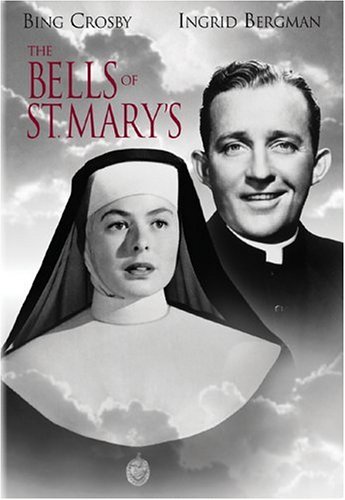
The Bells of St. Mary's (1945)


This film is about a young priest named Father O'Malley who goes to be the resident pastor at Saint Mary's school. The school is in disrepair and will have to be shut down unless a donor provides a new school. A wealthy business man is constructing a building next door, but alas, he wants to buy Saint Mary's to build a parking lot. The sisters are very worried, and the new pastor seems to be in cahoots with this wealthy man. What will happen to Saint Mary's?

I was really disappointed with this film. I was hearing these glowing reviews about a wholesome family film and what a classic this was... I couldn't believe I was watching the same film. This film is slow-paced and dull. It also misrepresents the Catholic faith. There may be some who are hesitant to watch film about nuns of priests, and this is not my argument. There are actually several great films that are about or take place in a religious context, a prime example being The Trouble With Angels. No, this one just missed the mark for me. There's a scene where a boy is getting bullied by one of the other students, and Father O'Malley is just looking on and even comments to Sister Superior that the boy is weak. Sister then trains the boy to box. This is so against the Catholic philosophy in so many ways that I cringed to watch it. A real Catholic priest would not condone fighting or bullying, and does not define manhood by who can hit harder. The Sister Superior actually did have the correct philosophy of peaceful resolution (kind of), but then changes her tune when she hears what the pastor had to say. It tries to hard to win the audience over, and cheapens the message as a result. If you don't want to stick to the belief of a religion... don't base a film in a religious setting featuring religious characters. It's really quite simple. There were several other things that bothered me, but I'll spare you.

The pacing, as I've mentioned, is quite slow. I almost stopped watching the film out of pure boredom and didn't care if the school was torn down or what. Also, as you may well imagine, the school is not shut down because the wealthy business man next door has a miraculous change of heart after some mind games played by our number one pastor and gives them the building for the school. I just don't feel that it was at all a plausible outcome. It's a convenient ending to stop a mediocre film. Not worth the time.
Thursday, 19 December 2013

The Three Faces of Eve (1957)

This film starts out with a man giving a grave disclaimer, stating that the events in this film are based purely on true events. That most of the dialogue is in fact taken from the actual patient records of the so-called Eve White herself. The film is based on a real life account of a doctor's interactions with a patient who had multiple personality disorder.

We first meet Eve White in her psychiatrist's office. She explains that she suffers from blackouts and very bad headaches, and also that her husband seems to accuse her of things that she has no recollection of doing. It seems to be clear to the doctor that she has some sort of psychosis, but he's not exactly sure what... until during one therapy session she transforms into an entirely different personality before his eyes. He discovers that she has multiple personality disorder, and that she in fact is not the only person living inside her head. It eventually comes to light that three women reside within the body of Eve White. Eve White herself is a very timid, defeated housewife, and is completely unaware that she is sharing her body with another person calling herself Eve Black, who is the exact opposite of her. She's rambunctious and promiscuous and almost childish in her abject selfishness. She claims that she is not married to Eve White's husband and is not the mother of her child. She instead prefers to go out dancing at the local bar many a night. The final personality gives herself the name Jane, and we do not learn much about her when she is introduced. In fact, she knows very little of her own self. The psychiatrist works hard to understand how the personalities interact with each other, and tries to get them to coexist. He is also wildly curious about the event in Eve's past that may have caused this splitting on her personality and works very hard to discover it.

This is a pretty gripping film. Joanne Woodward does a great job of seamlessly switching between the different personalities, and performs each of them so believably well. Watching her work, I found that I did not even once wonder if she suit the role of the different personalities she was portraying because she performed them all so well. One could rightly believe that the performances were genuinely different characters, and she was able to transition from one character to another so quickly and smoothly also. There was no contrived 'transformation' from one personality to another, the transition took place largely in her head and she demonstrated that effectively.

Another interesting thing about film of this nature, in this era, is the fascination with mental disorders and the relation that disorder has to a past trauma. It's really fun watch the characters dig through the past to discover the cause of what ails them.

The characters and story went into just enough detail about the personal lives of the girls and displayed enough emotion each of them were feeling about their situation to create compelling hold on the viewer. Though I may not have liked all of the character types, I was genuinely interested in what was going to happen to them and how, or even if, the hopes and dreams they had about fulfilling each woman's own personal needs and desires would be fulfilled.


Wednesday, 13 November 2013

Imitation of Life (1934)

This story is about two mothers who make a fortune together, and their relationship with their daughters. The story opens with a white mother, Bea, dressing her daughter Jesse, when the phone rings and she goes downstairs to answer it. Upon hanging up, she sees a matronly black woman, Delilah, at the door who is answering an ad for a live in maid. Bea hadn't put an ad in the paper however, but before sending the woman on her way, she discovers that Delilah has a young daughter, Peola, and because she refuses to abandon her, is having difficulty finding a job. Bea agrees to take her on without pay so that Delilah and Peola have a place to stay. Bea has taken over her late husband's syrup selling business, and goes out every day to try selling it. One day, Delilah is making pancakes from Bea before she goes out to work, and Bea really likes the pancake recipe. Delilah tells her that it's a family secret, but shares it with Bea. That very same day, Bea goes out and rents a storefront... to set up a pancake house. The business is successful, but not booming, until one day a homeless looking man walks into the store and Bea offers him some pancakes on the house. He then suggests to her that if she wants to make it big, she should take the route that Coke took and bottle it... or box it, the mix that is, and sell the flour to people. Bea loves the idea and even makes a smiling picture of Delilah the company logo, calling it Aunt Delilah (Aunt Jemima much?). And so begins the story.

The business continues and they make a lot of money (mostly Bea, as Delilah doesn't seem to get the concept of making money... why would the black character not want to continue living a subservient life when she could be a millionaire? Great writing here), but as the girls grow older, problems arise. Peola struggles the most in this film with her relation to race. As she is light enough to be taken for a white girl, she scorns any evidence of her black history... namely her mother. She wants to try to move as far away from the idea as she can and often tries to blend in with other white people and succeeds, until her mother comes into the picture. We do not see as much dissension with Jesse (because of course the white girl would be sweet and obedient), until Bea's beau comes into the picture. Jesse quickly develops a crush on him, leaving Bea with the difficult decision of which of them she will choose.

This was a good film... if somewhat racist, but remember that this is the 1930's. Delilah is portrayed as the sweet hearted, but not so bright woman who only knows and wants servitude for herself. Her daughter Peola is nothing like her mother and, maybe because of that, is always causing grief with her own apparent selfishness. That is not to say that she is shown in a negative way, but not much sympathy is given to her for wanting more for herself than the discrimination and blind hatred faced by black people in those times. Also, this film tries to position Bea as having this heart of gold for having a soft spot for Delilah and taking her and Peola in, but she shows little concern or care for them and their plights for most of the film. She will be around and make appropriate facial expressions, but doesn't actually comfort either of the two when they face hardship. I don't know if this was the way the part was played or if the actress just felt this way and didn't properly disguise it, but there is an air of inherent superiority in Bea's dealings with Delilah. Even at the beginning of the film when she invites Delilah in and eventually allows her to stay, I got the sense that she didn't like her and wanted her to go. In commonplace interactions, Bea is somewhat distant and slightly patronizing with Delilah, and then when she's doing something 'charitable' she over acts it. It's actually quite fascinating to watch. Then there is also the fact in the plot that Bea essentially stole Delilah's secret pancake recipe and exploited it for her own profit, and then even made Delilah clean the store, cook the pancakes for the customers, and be the face of the product, all for the honour of working as her maid and nanny. Needless to say this would be in the lineup of interesting film to watch if one were to try piecing together the history of white/ black relations.

Aside from the politics however, I found the film to be enjoyable. It falls flat when compared to the 1959 remake, but is still a worthwhile watch.


Apparently this was the trailer targeting the black audience of the day


Friday, 6 January 2012

Child Bride (1938)

This movie was made as a sort of social statement against men marrying girls, which was apparently common practice in some places. The story takes place in a hillbilly community up in the mountains somewhere and the local teacher who was born to the town but went away for school, Ms. Carol, is determined to stop child marriage.

We are first introduced to Jennie and her family. Jennie is a young girl around 9 or 10 years old who lives with her mother and father. She does her chores, likes school, and plays with her childhood sweetheart Freddie whenever he happens around, which is often. Jennies father is a good man who runs a local logging or milling business. His partner Jake on the other hand, is a mean sort and bullies those weaker than himself. One day, Ms. Carol goes around a little too vocally trying to convince people that child marriage is bad and Jake gets together some of the other men in the village to send her a message. They kidnap her at night and drag her into the mountains to what I assume would be tar and feather her, but Jennie's father steps in and stops them. Ms. Carol has a fiance back in the big city who happens to be a lawyer and though he desperately wants her to marry him, she will not leave this town until her mission is complete, and she asks him to try to get a bill passed that will end child marriage.

In the meantime, Jake cooks up something to get back at Jennie's father. He gets some of the other men in town to say that Jennie's mother had been fooling around with Jake. The father of course gets drunk and mad and goes home to beat his wife and pass out. Jake slips in and out when the ruckus dies down and stab's Jennie's father, killing him. Jennie comes home to find her mother huddled in a corner and her father passed out, but when she goes to put him to bed she finds that he's dead. Jake walks in at that moment and says that he'll blame Jennie's mother for the murder if she doesn't let him marry Jennie. Will Jennie have to marry the man? Will Ms. Carol be able to do anything to stop it? Will Freddie be forever without Jennie?!

This movie was pretty good. The acting was alright, the message was clear and the story was plausible. It was made in the 30's so it's not as graphic as something that might be made today, but the movie doesn't even suggest any sort of sexual harassment. It's more ideological than physical in making it's statement. I mean there is still the engagement between Jake and Jennie and it's suggested that the two will have relations when they marry, and that others have before them. And there of course the domestic abuse, but there is no suggested man on girl action taking place, so there's no worry on that account.

 
This is the trailer but the whole thing is actually on youtube so you can watch it there.

Thursday, 24 November 2011

The Bachelor and the Bobby-Soxer (1947)

This is a romantic comedy starring Carey Grant, Myrna Loy, and Shirley Temple. The story follows a high school girl named Susan who falls in love with a playboy of an artist who keeps running into trouble with the law, and he ends up going out with her too! Because of a misunderstanding at her school, Susan came to believe that the artist, Dick, wanted to use her as a model, and was thrilled because she was enamoured with him. Not knowing where she went, her sister Margaret became very worried, and when she found out where Susan had gone, was very angry with Dick. This wouldn't be a very big problem normally, but unfortunately for Dick, Margaret is a judge. Instead of sentencing him to do jail time, she tells Dick to pretend to go out with her sister to help her get over her teenaged crush.

At first things seem to be going according to plan, but Susan's infatuation shows no signs of waning, and even more concerting, there's a growing attraction between Dick and Margaret! How oh how will they all find happiness!?

A nice light romantic comedy with just a touch of drama. "You remind me of a man. What man? The man with the power. What power? The power of whodo. Who do? You do! Do what? Remind me of a man...."


My Favourite Wife (1940)

This is a great movie about a woman, Ellen (Irene Dunne), who returns to her family after being shipwrecked on an island and declared dead. When she finally returns to her home, she speaks to her mother who tells her that her husband, Nick (Carey Grant), has remarried on that very day. Ellen goes to the honeymoon suite to try to find Nick, and when he sees her he's shocked and overjoyed... and acquires a whole new set of problems!

He has never stopped loving Ellen, but doesn't quite know how to break the news to his blushing (but of course snobby, potentially mean-spirited) bride. They all end up going back to the house and Ellen tells Bianca (new wife) and the kids, who don't know who she is, that she is a cousin from the south. The new wife gets more and more jealous of the bond between Nick and Ellen, and Nick seems to find it increasingly difficult to tell her that Ellen is in fact his first wife.

In the meantime, Nick finds out that Ellen was not alone for those seven years, but was stranded with a man. Nick completely drops his issue with Bianca and goes out of his mind with jealousy trying to find this man. When he finally does, he discovers that the man is very attractive, and is in love with Ellen!!

Just when things can't get any more complicated, Nick is arrested for bigamy. How will he get out of this scrape and will he and Ellen ever be able to be together!?

I really enjoyed this movie. It was a lighthearted, romantic, screwball comedy with a cheeky heroine and a hilarious scenario. Fun for the whole family!