Showing posts with label school. Show all posts

Friday, 3 January 2014

The Bells of St. Mary's (1945)


This film is about a young priest named Father O'Malley who goes to be the resident pastor at Saint Mary's school. The school is in disrepair and will have to be shut down unless a donor provides a new school. A wealthy business man is constructing a building next door, but alas, he wants to buy Saint Mary's to build a parking lot. The sisters are very worried, and the new pastor seems to be in cahoots with this wealthy man. What will happen to Saint Mary's?

I was really disappointed with this film. I was hearing these glowing reviews about a wholesome family film and what a classic this was... I couldn't believe I was watching the same film. This film is slow-paced and dull. It also misrepresents the Catholic faith. There may be some who are hesitant to watch film about nuns of priests, and this is not my argument. There are actually several great films that are about or take place in a religious context, a prime example being The Trouble With Angels. No, this one just missed the mark for me. There's a scene where a boy is getting bullied by one of the other students, and Father O'Malley is just looking on and even comments to Sister Superior that the boy is weak. Sister then trains the boy to box. This is so against the Catholic philosophy in so many ways that I cringed to watch it. A real Catholic priest would not condone fighting or bullying, and does not define manhood by who can hit harder. The Sister Superior actually did have the correct philosophy of peaceful resolution (kind of), but then changes her tune when she hears what the pastor had to say. It tries to hard to win the audience over, and cheapens the message as a result. If you don't want to stick to the belief of a religion... don't base a film in a religious setting featuring religious characters. It's really quite simple. There were several other things that bothered me, but I'll spare you.

The pacing, as I've mentioned, is quite slow. I almost stopped watching the film out of pure boredom and didn't care if the school was torn down or what. Also, as you may well imagine, the school is not shut down because the wealthy business man next door has a miraculous change of heart after some mind games played by our number one pastor and gives them the building for the school. I just don't feel that it was at all a plausible outcome. It's a convenient ending to stop a mediocre film. Not worth the time.

Friday, 23 December 2011

Mei-chan's Butler (Mei-chan no Shitsuji)

This is a high school drama about a girl named Mei whose parent's die. After their death she discovers that her estranged grandfather is very wealthy  and she will inherit his empire, but first must attend a fancy all-girl reform school to become a lady. This school isn't just any school though. There are no desks, but rather cushy arm chairs and side tables and the campus is a third the size of Tokyo, but the weirdest thing of all about this school is that all of the girls must have butlers.

Mei is sort of resistant at the thought of becoming like these weird people, but eventually finds a reason to stay despite her reservations. Of course there are several people who are against her being there and make life hard for her. One girl in particular, the girl who has earned the highest rank on the lady- scale in the school, turns out to be her rival (in more ways than one), and even after she wins over some of her classmates, it is this adversary who is the real trial for Mei. The girl- butler dynamic is important to the plot. We learn as we watch that being a butler isn't just about waiting on someone hand and foot, but that there is a special bond between master and servant, and that the servants choose to serve.

I thought overall that the drama was interesting in theory, and the story line was well done, but the heroine was kind of pathetic. She was always whining or moping about. When she had a problem she would just stand there dumb-struck until someone saved her or until it was almost irrelevant for her to step forward. I also didn't like the actress who played her. She has one of those faces that seem to always be frowning, or smelling something disgusting, and yet her character was supposed to draw people to her and see how amazing she is. For the most part the characters weren't extremely attractive, but in addition to her unattractiveness, she couldn't act. If they had chosen a different actress to play the heroine this drama would have been much better. As it is though, it's still worth the watch.


The whole thing is actually up on YouTube for the time being, so knock yourself out.


Saturday, 17 December 2011

The Emperor's Club (2002)

This is a movie about a teacher in what was an all boys school reminiscing about the past, and how one's character dictates one's future.

Mr. Hundert teaches the classics at a prestigious all boy's high school. Every year he holds a 'Julius Cesar competition' which is a series of trivia questions about the ancient world, and the student who answers the most questions correctly get the prestigious title of Mr. Julius Cesar. All of Mr. Hundert's students are hard working, studious boys who take their education very seriously, all until a new student enrolls in the class, a Mr. Sedgwick Bell. This kid isn't very bright, but is very charismatic, and very soon his disregard and contempt for school begin to rub off on the other students.

Mr. Hundert speaks to Sedgwick's father, a high-ranking man who seems to care little for his son, and Sedgwick seems to try to improve academically after that. He goes as far as to climb to the top of his class! Unfortunately he places one spot lower than is necessary to qualify for the Julius Cesar, so in an attempt to encourage him, Mr. Hundert switches his name with one of the students who actually got in. Unfortunately, this proves to be a mistake when he catches Sedgewick cheating during the final. Instead of humiliating him in front of the assembly, he asks a question that he would only have known by paying attention in class. The question had to do with the identity of a man named Hamiclar Barca, and could not be found in any textbook, so Sedgewick of course couldn't answer it. After this, he reverted back to his old self, causing trouble and being an all around delinquent.

Fast forward to present day, a very successful and wealthy Sedgewick called together a friendly rematch of the contest and asks that Mr. Hundert conduct the ceremony. What will happen I wonder.

The movie prods the viewer to consider a person's character, and how that character may or may not decide a person's life. More importantly, it puts forward the idea that, no matter how charismatic, successful, or popular a person is, unless he or she makes some sort of contribution to humanity, they will not be remembered. The man Sedgewick was asked about, Hamilcar Barca, was used as an example of this. He was a successful Carthaginian general who led many battles and caused many deaths, but his name will not be in any textbook because he made no contribution to humanity. He made an impact on the world, but unlike Julius Cesar, Socrates, Hammurabi, etc. he did nothing to better man-kind.

The story is well done, and while it's not overly philosophical in nature, it doesn't discourage the viewer from thinking further about some of the ideas they present.


Thursday, 24 February 2011

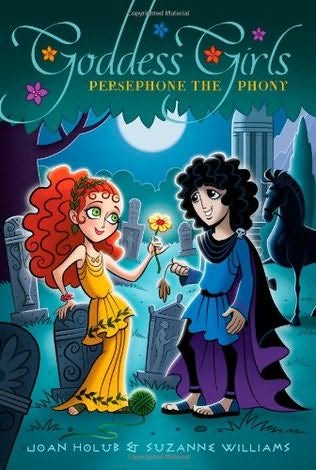
Persephone the Phony (Goddess Girls) by Suzanne Williams and Joan Holub

Goddess Girls is a cute series for young girls about goddesses from Greek mythology, namely Persephone, Athena, Aphrodite and Artemis. This is the first book I've read in the series and I was drawn to it because I've always liked the story of Persephone and Hades, and though the story is called 'The Rape of Persephone' I've always considered it to be more of a forbidden love story than Hades taking her against her will.

The goddesses in this series are 12, the supposed age of the potential reader and all of the gods and goddesses interact mostly at god- school, with Zeus as the principle. Persephone is a shy girl and always goes along with what her friends want to do or are interested in instead of saying what she would like to do, and because she is always going along with her friends and hides her real feelings she starts to think of herself as being phony. Then one day after school, Aphrodite convinces Persephone and Athena to go shopping with her. She is convinced to buy a ball of yarn (among other things) and on her way home she drops the yarn and it unravels and falls down to earth to a cemetery. Persephone goes after it and when she gets to the cemetery she is intrigued by it, as she has never been to one, and she finds that she feels very calm in this place. Then, the ground shakes and opens up and out comes a young Hades on a black stallion. They get to talking and Persephone finds that Hades is quite a nice person and inspires her to say what she's really feeling, but alas the meeting is interrupted by Demeter, Persephone's mother, who gets angry at Persephone for not telling her where she had gone. As the story progresses, Persephone and Hades have a few more chance encounters (almost every time someone warns her away from him) and Persephone starts feeling like she should stand up for herself more. Aphrodite asks her to go shopping again and this time she refuses and goes to see Hades instead, but on the way there she sees a pomegranate orchard and stops in for a bite.  Hades comes up and they have some fun spitting the seeds but as it turns out her friends were spying on her and tell her mother what she's been up to. Persephone is angry at everyone for this invasion of privacy and runs away to the underworld with Hades (instead of being dragged) and tells him that she's tun away and wants to live with him. In contrast to the myth, he actually sends her back however, telling her that the underworld isn't a place for her and that her mother would be worried. Persephone has a talk with her mom and then seeks Hades out at school the next day and he asks her to go to a dance.

It's not exactly the myth, but the main pieces are in the right place. They meet on earth, and Persephone's making a daisy chain at the time, so she's still interacting with nature at some level when he meets her. The pomegranate is still the turning point in their relationship, after that she begins to act more in her own interest instead of going along with what other people say, and after that point they end up getting together. And she did go down into the underworld, she was just sent swiftly back to mount Olympus. Overall it was an enjoyable read and a fun interpretation.. and maybe an introduction for some kids, to some of the more well-known female goddesses in Greek mythology. I haven't read any of the other books, but this one was pretty good so I would think those are ok as well.

Sunday, 7 November 2010

The Princess Academy by Shannon Hale

Miri, named for a small flower that grows in the mountains, is a 14-year-old girl who lives in a mountain village. All of the people in the village work in the mountains to quarry the precious rock, which they in turn barter for food with traders from the lowlands. Everyone work in the quarry. Men, women and children all have a role to play, whether it's mining, cutting, or even delivering water to people busily hammering away, everyone except Miri that is. Her father has forbidden her to work with the rest of the village in the quarry and Miri believes this is because she is so much smaller and weaker than everyone else, so she has always felt somewhat left out. All is normal in the small village until one trading day when along with the lowland traders comes an emissary from the royal palace saying that all of the girls in the village would have to attend a princess academy because the prince would be choosing one of them to be the new princess. As is tradition in the kingdom, the royal oracles have a vision that tells them which village the next princess will come from. There is then a princess academy opened up in that area to prepare the eligible young girls to meet the prince and have him choose one of them. Up until this moment however, Miri's village had never heard of this tradition. The only real contact they have with the rest of the kingdom is through the traders. Miri and several of the other girls go to a makeshift school some distance away from the village and are taught to read as well as think and act like polished young ladies found in a royal court. Miri, as well as several of the other girls enjoy learning these new things and realize just how far removed their little village was from the rest of the kingdom and just how much they did not know. As the girls learn more and the day the prince will come gets closer, the competition between the girls get fierce and Miri feels more alone than she ever has in her life. Despite this, Miri remains strong and even finds some unexpected friendships. Trouble falls upon the girls and Miri takes it upon herself to save both herself and the girls from the danger.

Miri is a spunky heroine. Because she is so small she acts larger than life. She can be kind of mouthy at times and you can picture her as one of those tiny people who never stop talking. There are moments when her personality is almost too big to be believable and kind of obnoxious, but the author does a good job of stopping at that point. There is a thin line between spunky and obnoxious and though Miri has moments of coming close to being obnoxious, she is mostly just high- spirited. She is a proactive heroine which is great. She always tries to make the situations she is in work for her. She doesn't just stand for injustice or bullying, she acts in a way that will best accomplish what she is ultimately after, which is surprisingly not the prince. Miri is interested in the prince, but she's not boy-crazy. She actually gets more out of learning at the academy than she does preparing for the prince and actually uses her knowledge to help her village. In many of these prince princess stories the heroine is insanely in love with the prince and want to become a princess, but Miri notes practically that she's never even met the prince. As the story progresses Miri thinks more and more that she wouldn't mind being picked by the prince, but this is because she wants to see more of the world and not so much because she's in love with the title. In that sense the heroine reminded me of the heroines of the Alanna series by Pierce and the Enchanted Forest Chronicles by Wrede.

The story also really promoted education. As Miri learns more and more her desire to learn becomes voracious and she tries to learn as much as she can. She then applies what she learned to various situations, and this can really help children see the wonder in learning and the reason we learn things. A common complaint I've heard in school is that the kids don't know why they're learning what they're learning. This book could be an inspiration of sorts to these kinds of kids, more to girls than boys due to the subject matter.

Overall I think this was a good read. It isn't ground breaking topic-wise, but the heroine has a back-bone. The story isn't an adventure, but there is action, danger, suspense, and a little bit of romance. The story a mix between a fantasy and a Victorian novel for kids. Pretty good read.

Monday, 9 August 2010

Oh My Teacher

These are some movies I like that either take place in a class room or are about teaching or passing on information.

To Sir, With Love

Dead Poet's Society

The Emperor's Club

Finding Forrester

Mr. Holland's Opus

Dangerous Minds

High School High

Take the Lead

Anne of Green Gables- The Sequel

GTO - Great Teacher Onizuka- there's also a live action drama for this

Karate Kid

Freedom Writers

Blackboard Jungle

Lean On Me

Coach Carter

The Great Debaters

Akeelah and the Bee

Accepted

The Principal

The Substitute

Teachers

Misunderstood Minds

Wednesday, 30 December 2009

Sunday Chutney by Aaron Blabey

This is a fun book about a girl who's always the new girl. Her parents are always moving from place to place so she's been all over the world and has seen many things.. but as a result she doesn't have any friends and is always 'the new girl' in school. Despite this however, Sunday has a really bright outlook on life. Right after she says something depressing she bounces back with something funny or quirky. She has an amazing imagination and is not afraid to use it. For most of the book her imagination seems to make up for her lack of friends, but at the end she says that making friends is something she's good at and shows her with a group of girls.

This is a good book to give a kid who moves around a lot or one moving once to a new place. It voices the fears kids have in these situations, but is fun enough to almost side-step the unpleasant feelings associated with moving. She has a lot of interests and is really up beat. A fun book.


Monday, 2 November 2009

Violet ~ Tania Duprey Stehlik

 Violet is a girl who lives in a world where all of the people she knows are the colour of primary colours. One day her dad picks her up from school and a friend asks why her dad is blue and she is violet. Violet is a little upset by this and begins to question why she is different from all of the kids at school and even from her own parents. She goes home to ask her parents and her mom, who is red, while her dad is blue, sits her down and tells her that it's not a bad thing to be different from the kids at school. She puts blue and red paint on a piece of paper and mixes them together to demonstrate that violet is a combination of her mom and her dad, making her special because she is a little bit of both of them. Violet feels happy that she is a bit of both her parents and the next day at school tells the friend so with pride. 

This is a good book to introduce racial difference in a very non-confrontational way. The different colours could represent different things to different people, but it teaches that though you may be different from people on the outside, you should always be proud of who you are because you are a special person. Blue and red are pretty generic colours, so it isn't a book about certain races or orientations, but is abstract enough to let anyone insert themselves.

Thursday, 16 July 2009

The Name Jar by Yangsook Choi

I enjoyed this book. I was in the book store one day and it caught my eye so I flipped through it, and I'm glad I did. 

It's about a little girl who comes from Korea and moved to North America. She goes to school and doesn't want to tell the class her name because it is different. She says she doesn't have a name, so her classmates make a name jar for her and put in names that she can use. Then she gets a letter from her grandmother who is still in Korea saying how much she loves her and in the letter was a seal with her name on it. After getting this she is once again proud of her name and goes back to school and tells her class mates her real name and what it means (I apologize if I got some of the details mixed up it was a while back that I read it). This book was a tear jerker for me. I'm not Korean, nor have I had major problem with my name (though people often mispronounce it when reading it), but the struggle for the acceptance of one's self and one's own difference in comparison to others is something we all go through, and this story successfully displays that struggle and overcoming that struggle in a simple way. I think its a good way to get children to understand that though they are different, they will be accepted by someone, and opens them up to other cultures at the same time. Worth the read.