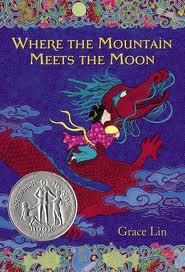
This is the story of a poor young girl named Minli. She lived with her parents in a village near Fruitless Mountain, named so for the fact that it was barren due to the anger and pain of a dragon. Every day Minli and her parents worked hard in the rice fields to make just enough rice to feed themselves, and every night Minli would sit with her parents. Her mother would sigh in anger at their misfortune and her father told her folktales about dragons, evil magistrates, and the Old Man of the Moon (an immortal who read from the book of destiny).
One day a goldfish peddler passed through the town selling his wares, saying that a goldfish would increase the buyer's fortune. Hearing this, Minli took one of the two copper coins to her name and bought a fish. Her mother is furious with her and tells her there that there is barely enough rice for the three of them and that they would never be able to feed another mouth. The night following this conversation, Minli decided that her mother is right and released the goldfish. As soon as she did so however, the goldfish thanked her! She was startled to find the goldfish talking to her, but was told that all goldfish talk, but only those who want to listen can hear. The goldfish then tells Minli how she can find her way to Never Ending Mountain, home of the Old Man of the Moon, so that she could try to change her fortune. This sets Minli off on a journey to try to change her family's fortune. She meets various characters, dragons, goldfish, places, people, all of which she heard of in folk tales and fairy tales.
When I first began reading this book I didn't understand why it had won the Newbery Award. The story seemed pretty typical, kid goes on an adventure, meets some people, learns a lesson, that old thing. But as I read on I found the story to be more than that. All of the folk tales, even the plot itself were taken right out of a Chinese folktale, and all were seamlessly interwoven. If a folk tale was told early on in the story, Minli would interact with the people in that folk tale later on in the plot. So often fantasy and make-believe and imagination is passed off as a foolish waste of time with no practical application in the real world. This story reminds us that folk tales do come from somewhere, that there are lessons we can learn from them that we can apply to our own lives, and most importantly, we can see how stories give Minli and her family hope and happiness.
Showing posts with label folk tale. Show all posts
Friday, 29 April 2011
Tuesday, 25 August 2009
Clever Katya: A Fairy Tale from Old Russia by Mary Hoffman
This story is about a girl who uses her head to help out her father who gets himself in trouble over a donkey. A man gave Katya's father a horse and that horse had a baby with the father's mare, so the guy who first gave the horse wanted the foal, so he took the case to the tsar. The king gives out a riddle to the two men and says whoever answers the riddle gets the foal. The riddle is 'What is the fastest thing in the world, what is the fattest thing in the world, what is the softest thing in the world and what is the most precious?' The other guys asks a neighbour who owes him some money and the father asks Katya. I won't tell you the answer, but I'll say that Katya won. The tsar was interested in these answers and asked the father who told them to him, to which he replied his daughter. So the king asked the father to bring Katya to him, but he said that 'She must come neither on horseback nor on foot, neither naked nor dressed and neither bringing a present nor empty handed.' So she goes to him in the way he asked, and at the end of the book he marries her because she was the most clever person in the kingdom.
This was a nice story based on an old Russian folktale. The pictures are beautiful and colourful with nice traditional, colourful borders surrounding them. I first heard this story in grade 3 or 4 and it was one of those that I remembered to this day. It's one of those odd books you'll find where the girl gets the guy because of her brain, not her beauty. a beautiful story. I recommend.
Tuesday, 4 August 2009
First Strawberries by Joseph Bruchac
This is the legend of how the first strawberries came into being, and it's kind of nice because it's a love story. I'm going to summarize it so if you don't want to know skip over.
One day a husband comes home from hunting to find his wife picking flowers instead of cooking. He angrily reprimands her for this and she indignantly walks off. The husband immediately feels sorry for getting so angry and tries to catch up to his wife to apologize but she's too fast for him so he asks the sun to slow her down. The sun shines itself on various berries but the wife is too angry to see them so the sun makes strawberries right on the ground so the wife would see them, and voila the first strawberries. The wife sees them and thinks to herself that it would be nice to share these with her husband so stops to pick some. The husband catches up to her and they live happily ever after.
It was a nice story. I enjoyed it.
Seven Daughters and Seven Sons by Barbara Cohen
The story was set up well and the characters were discussed in sufficient detail, or enough so that a reader of the target age wouldn't be left wondering anything. It was well written. |
The Persian Cinderella by Shirley Climo
This was a great story! And according to the back of the book, is the story 'The Anklet' from the Arabian Nights. I thought it was very well told, I didn't really like the pictures though. They kind of look like figures posing instead of characters in the story, and there are noticeable outlines around the people so as to make you think they're cut outs, or are not a part of the scenery they're presented in. The over posing and the not fitting into the background kind of reminds me of cheesy picture books I read from the 80's. Now these pictures aren't as bad as those, but the way they are presented are reminiscent of that... style. I still like the book and think it's worth reading as the storytelling was well done.
Friday, 17 July 2009
Once Upon A Winters Night by Dennis Mckiernan
East of the Sun and West of the Moon is one of my preferred stories from mythology, and this book did it little to no justice. I didn't connect with the heroine at all and at times felt like she was trying too hard and with not enough motivation. I felt that the author was making her out to be more clever and strong than she actually was, which is annoying. I mean, we all love strong, smart, courageous heroines, and because we love them we can tell when someone doesn't fit the bill, however hard the author tries to boost the character's image in the eyes of the reader (the truth always comes through).
Also, there's suggested bestiality in the story, which is cool, I mean besides the fact that some people are into that, it can symbolically bring a raw, primal aspect to the story, but not in a book intended for something of a younger audience. I am not against younger people becoming familiar with what sex is, as it would be absurd to hide it from them beyond a certain age and not do them some sort of harm, but the... flavour of sexual experience they are aware of should be left to human on human until later on... if ever. This may be my inner prude coming to light, but I would be hesitant to give it to anyone younger than me for fear that they might pick up on the suggestion.
I didn't completely hate it because I like faeries, and I suppose I appreciate the author's attempt to incorporate faeries into the plot, what with the red caps n such, and the prince being kind of a faery himself, so I put aside the poor writing for one of my obsessions, but other than that I deem it to be a failed attempt.
I've just finished reading another retelling called East by Edith Pattou. I found that to be more successful. The story is a good one, this was just a bad version of it.
The Little Mermaid by Charles Santore
This was the first little mermaid story I was aware of. I'm not really a fan of Disney because they alter the stories, among other things, and so in retrospect I thank my mother for getting me this book when I was young. The story is beautiful and the pictures are as beautiful as the story. This is my standard for the little mermaid story and to date all other renditions I've read have been sub-par in comparison.
Labels:
art,
book,
fairy tale,
folk tale,
illustration,
little mermaid,
santore
Thursday, 16 July 2009
My Neighbor Totoro
The first maybe 15/ 20 minutes of this movie are really annoying and just seem like these two girls are running around trying to be cute and carefree. Those few minutes made me acutely aware that I was an adult watching a child's movie, in the most unpleasant way possible. Thankfully it improves. In fact, if you play the movie again right after you've seen it once, you'll most likely still have the happy/ magical feeling and will still feel a connection to the characters, so can pass of the annoying as...... endearing.
The girls take us on a journey, seeing the world through their eyes. The story begins when the girls and their father move to a new house in the country. When they get there they start bumping into spirits, and continue to do so throughout the movie. The story itself is a very plain story about two girls living their regular lives, waiting for their mother to come home from the hospital, but this magical world that only the girls can interact with and see takes the story to a whole other level. The magical beings the girls interact with can easily be rationalized as the imaginations of these two girls as they make more of their surroundings than is actually there (for example the soot gremlins could be just dust balls), but even if that is the case, it makes the story that much more fantastic. A child, who is already prone to accepting the fact that magic can exist, will accept this story as it is presented, two girls who meet forest spirits. an adult however, much more skeptical than a child, may not do so and will look for instances to rationalize away the magic (soot gremlins = dust balls), and to that adult this story has the wonderful lesson of seeing the extraordinary in the ordinary. That's also why it helps to watch the movie twice as an adult to enjoy it, you get over your inhibitions and desire to make it fit into your own life after seeing it the first time, for those who don't need the first time I salute you. It's a wonderful movie, and as it's a Myazaki film, definitely worth the watch.
Glass Slipper, Gold Sandal: A Worldwide Cinderella by Paul Fleischman
This is the Cinderella story, but each section of the story is taken from a different telling of Cinderella from around the world. the idea's nice... but i don't think it worked out. Instead of it being the story of Cinderella it was a book saying that more than one country had the Cinderella story... which is nice, but I'd prefer to have each of those stories told to me instead of having them all smushed together not being true to any of the stories but just delivering the general message they all share. Each Cinderella story is similar, but the story from each country does differ and therefore the stories are somewhat different, as each is being told through the eyes of a different culture and therefore places importance on different things. To me it feels like this story is trying to say 'we're all the same, all exactly the same' but I disagree with that, we're all different, and that's wonderful... so lets joyfully experience the difference instead of trying to make us all the same.
Needless to say I would have preferred a compilation of stories rather than smushing them all together and doing justice to none of them. I truly dislike this cardboard sense of multiculturalism and hope this author doesn't get his hands on any more like material.
The Secret of Roan Inish (1994)
This is my absolute favorite movie and has been ever since I was a little girl. My mother actually introduced me to this movie and since then I have become addicted to all things mythological (I probably would have gotten into it anyways, but this sped up the process).
It's a story about a girl who goes to live with her grandparents for a while because her father is too busy with work to care for her. While with her grandparents, she visits an island her family used to live on. This is also the island where her younger brother was taken away by the sea. She snoops around the island and catches glimpses of a small boy she suspects to be her brother. As it turns out, selkies have taken him away. So the girl, with the help of her cousin, begin to make the abandoned houses on the island habitable again so that they can move back, thereby getting the girl's brother back from the sea.
This film is subtle, yet superbly effective in giving you that evanescent, magical feeling. So many movies try to capture that evasive 'something else' but end up being fake and cheesy but this one makes the cut. It's suitable for all ages and is a definite must experience. The soundtrack isnt bad either.
Wednesday, 15 July 2009
Fairy Faith In Celtic Countries by Wy Wentz
This book is a good source of fairy culture from Ireland, Britain, Scotland, Wales, Cornwall and the like. There are a lot of case studies in the beginning, so if you don't like those, stay away- or just skip over it. The author of this book is an anthropologist who went around the British Isles collecting fairy lore. He uses both stories from the people he meets and later gets into different aspects of the fairy faith. This is a wonderful resource and a must read for all seriously obsessed with fairies
Labels:
anthropology,
book,
britain,
case study,
faeries,
fair,
folk tale,
ireland,
scotland,
uk
Thursday, 9 July 2009
Baba Yaga and Vasilisa The Brave by Mayer Marianna
Basic plot outline (so if you'd wish to remain oblivious please skip over the first paragraph)
This is the story about a girl who is sent by her step mother to the evil witch in the woods to borrow a light. It starts off like the Cinderella story with the father remarrying a woman with two daughters and then dying, leaving his daughter to be mistreated by the stepmother and stepsisters. The stepmother is jealous of the girl's beauty and sweet disposition in comparison with her own daughters so she sends the girl out into the woods to seek out the evil Baba Yaga to ask for a light. the thing about the witch is that very few people who meet her live to tell about it. The witch eats people and has a house built out of their bones. So the girl goes obediently to the witch and she takes with her a doll her mother made her before she died, and the doll is magical, because it was made with her mother's love. So when she gets to the witch and asks for a light the witch agrees to give her a light if she can complete the tasks set before her, which are to cook huge meals and clean everything. The Baba Yaga leaves and the girl frets over what to do and then her doll comes alive and does most of the chores for her. The witch is satisfied and gives the girl one of her lights which when she presents to her stepmother, burns the stepmother alive. At this point, though she wasn't the strongest heroine ever, I'm hopeful for a strong ending, thinking maybe she won't need to get married at the end of the book to justify the plot... but she does, and it's not a bad thing, I'm just getting a bit bored with the same ending over and over (in both adult and children's stories).
This story had more of a classical fairy tale feel to it. It had a dark atmosphere to it with the beautiful illustrations, which at some points I could see very small children being afraid, of the Baba Yaga for example, but for the most part I felt they kept the story pretty clean. It could have definitely been very much more graphic, which I would have loved, but this is a children's book. What I enjoyed about this book was that things had to be a certain way, things HAD to get done, like in older stories. Even though the stepmother treats her very poorly, the girl still obeys her and minds her, and from a feminist perspective this can be seen in a very bad light. A submissive girl with no back bone and no will of her own, an abusive relationship in essence. But, if you look at it as something produced a time long ago, when morals were different, and from a fairy tale perspective, where (if you know your mythology) everything has rules, very strict rules that must be followed, as the sequence is almost as important, if not more so, than the final product, it's more fanciful and exciting and much more archetypal, like the an old fairy tale. In most of today's stories we tell kids that nothing binds them and they can do whatever they want, and while it is good to leave an abusive relationship and all kids must learn that this is a good thing, people will always be bound by something, something that stays their hand or forces action, maybe sometimes against their will, and a lot of children today (myself included) don't really grasp this concept because all our lives we've been fed the fairy tale that we control our own destiny and what i say goes.. but that's not always the reality. Lessons like this can be learned from fairy tales of this nature.
Craft's illustrations are absolutely gorgeous and I wish there were more of them in this book. The subject matter had the potential to be scary, so I think the scenes depicted were selected carefully and on some pages only a small picture was provided in the corner... but this illustrator is so good that anything she does is magnificent. I wish the whole book was full pages of her illustrations. The prose was good as well though. It had a decent flow and was over all pretty well done.
Labels:
book,
children's books,
dolls,
european,
folk tale,
k.y. craft,
kids,
magic,
witch
Wednesday, 8 July 2009
Atanarjuat: The Fast Runner (2003)
This movie was kind of slow paced, but once you kind of set yourself to that pace, it was pretty good. I think at one point they said the story is pretty universal among the Inuit, in the credits or the 'how it was made' part. It's basically about this guy named Atanarjuat, the fast runner, and it takes us through his life. The way it's told, now that I look back on it, has many of the same aspects as some of the less fantastical legends I've heard. The plot had a kind of 'epic' feel to it I guess.
It was a very... real movie. There was no Hollywood drama or special effects, you felt like you were right there with them. It was a fascinating look at Inuit life and culture, and was pretty well done
Subscribe to:
Posts (Atom)