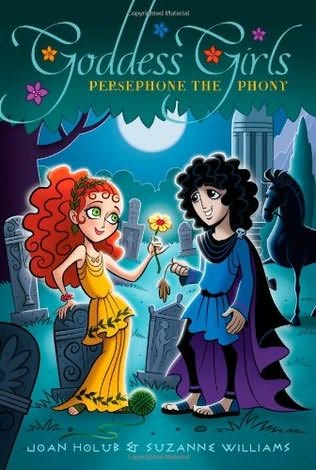
Goddess Girls is a cute series for young girls about goddesses from Greek mythology, namely Persephone, Athena, Aphrodite and Artemis. This is the first book I've read in the series and I was drawn to it because I've always liked the story of Persephone and Hades, and though the story is called 'The Rape of Persephone' I've always considered it to be more of a forbidden love story than Hades taking her against her will.
The goddesses in this series are 12, the supposed age of the potential reader and all of the gods and goddesses interact mostly at god- school, with Zeus as the principle. Persephone is a shy girl and always goes along with what her friends want to do or are interested in instead of saying what she would like to do, and because she is always going along with her friends and hides her real feelings she starts to think of herself as being phony. Then one day after school, Aphrodite convinces Persephone and Athena to go shopping with her. She is convinced to buy a ball of yarn (among other things) and on her way home she drops the yarn and it unravels and falls down to earth to a cemetery. Persephone goes after it and when she gets to the cemetery she is intrigued by it, as she has never been to one, and she finds that she feels very calm in this place. Then, the ground shakes and opens up and out comes a young Hades on a black stallion. They get to talking and Persephone finds that Hades is quite a nice person and inspires her to say what she's really feeling, but alas the meeting is interrupted by Demeter, Persephone's mother, who gets angry at Persephone for not telling her where she had gone. As the story progresses, Persephone and Hades have a few more chance encounters (almost every time someone warns her away from him) and Persephone starts feeling like she should stand up for herself more. Aphrodite asks her to go shopping again and this time she refuses and goes to see Hades instead, but on the way there she sees a pomegranate orchard and stops in for a bite. Hades comes up and they have some fun spitting the seeds but as it turns out her friends were spying on her and tell her mother what she's been up to. Persephone is angry at everyone for this invasion of privacy and runs away to the underworld with Hades (instead of being dragged) and tells him that she's tun away and wants to live with him. In contrast to the myth, he actually sends her back however, telling her that the underworld isn't a place for her and that her mother would be worried. Persephone has a talk with her mom and then seeks Hades out at school the next day and he asks her to go to a dance.
It's not exactly the myth, but the main pieces are in the right place. They meet on earth, and Persephone's making a daisy chain at the time, so she's still interacting with nature at some level when he meets her. The pomegranate is still the turning point in their relationship, after that she begins to act more in her own interest instead of going along with what other people say, and after that point they end up getting together. And she did go down into the underworld, she was just sent swiftly back to mount Olympus. Overall it was an enjoyable read and a fun interpretation.. and maybe an introduction for some kids, to some of the more well-known female goddesses in Greek mythology. I haven't read any of the other books, but this one was pretty good so I would think those are ok as well.
Showing posts with label mythology. Show all posts
Thursday, 24 February 2011
Monday, 5 October 2009
Princess Mononoke (2001)
This movie is a classic. The animation is spectacular and the story very well done. I happen to be somewhat into Japanese culture as of present, but before I was so into it, and people who I know now who are not into it, sometimes Japanese media goes over their heads. The cultures are kind of different and place importance on different things and when a person used to seeing one kind of story or moral repeated over and over in different ways sees something else... well they may not immediately appreciate it (an example of this would be how at the end he doesn't end up with the girl). This happens in almost every western movie because we are very focused on the 'happy ending' fairytale, validating the storyline with the 'kiss at the end', but that doesn't happen in all cultures). However, I found Princess Mononoke to somewhat transcend this confusion, because the story is so relatable and well told. I found it to be so when I first watched it, which would be late elementary school, and feel this way even more now.
The story can be translated in many ways, but the general message I got out of it was the modern attempting to erase tradition. The people of Iron Town worked hard to destroy the forest because by doing so they could earn a living in the new world making iron. The only way they could do this however was to cut down the forests, which meant that they would have to kill the gods from the old world, who were already dying out. The thing is that the Lady Osono is painted in something of a bad light as she is cutting down the forest and killing the gods, but she is an amazingly strong humanist. She's a proactive woman in a time and place where women weren't liable to have that status (the status might help to paint her as a 'bad guy' however, because even though we are making progressions, many people are still very sexist... I would bet you that if not you yourself, someone you know thinks that women are by nature evil or devious... in 2008). So when looking at it in this light Osono is opting for humanity. She takes in lepers, she saves brothel workers from whatever fate they would face in brothels, etc. and yet she's the 'bad guy'. Interesting to note at any rate.
Ashitaka is a great protagonist. A pacifist to the end. He goes on his journey to find something to remove his curse. Not for selfish reasons I don't think, but to right the wrong. He's a pretty selfless person. At the beginning of the movie, the reason he got the curse was because his sister was in the way of the cursed boar, so he had to shoot it, but before that he was trying to talk to it and calm it's anger. This is basically how he acts throughout the movie. He tries to get things done without violence, but if it comes to it, he will resort to violence to protect himself or those he cares about.
I didn't really notice the environmental message when I first saw it. I was more focused on cultural loss. But recently, with the environmental bludgeon the media has been playing around with, I noticed just how 'for nature' this movie was. Traditionalism would of course take the stance against industry which would be a way to save the forest, so it makes sense, but I guess I just went into it too symbolically. It does have a pleasant environmental message however, better than a lot of other animated environmental movies.
So, to sum up, this is a great movie.
The story can be translated in many ways, but the general message I got out of it was the modern attempting to erase tradition. The people of Iron Town worked hard to destroy the forest because by doing so they could earn a living in the new world making iron. The only way they could do this however was to cut down the forests, which meant that they would have to kill the gods from the old world, who were already dying out. The thing is that the Lady Osono is painted in something of a bad light as she is cutting down the forest and killing the gods, but she is an amazingly strong humanist. She's a proactive woman in a time and place where women weren't liable to have that status (the status might help to paint her as a 'bad guy' however, because even though we are making progressions, many people are still very sexist... I would bet you that if not you yourself, someone you know thinks that women are by nature evil or devious... in 2008). So when looking at it in this light Osono is opting for humanity. She takes in lepers, she saves brothel workers from whatever fate they would face in brothels, etc. and yet she's the 'bad guy'. Interesting to note at any rate.
Ashitaka is a great protagonist. A pacifist to the end. He goes on his journey to find something to remove his curse. Not for selfish reasons I don't think, but to right the wrong. He's a pretty selfless person. At the beginning of the movie, the reason he got the curse was because his sister was in the way of the cursed boar, so he had to shoot it, but before that he was trying to talk to it and calm it's anger. This is basically how he acts throughout the movie. He tries to get things done without violence, but if it comes to it, he will resort to violence to protect himself or those he cares about.
I didn't really notice the environmental message when I first saw it. I was more focused on cultural loss. But recently, with the environmental bludgeon the media has been playing around with, I noticed just how 'for nature' this movie was. Traditionalism would of course take the stance against industry which would be a way to save the forest, so it makes sense, but I guess I just went into it too symbolically. It does have a pleasant environmental message however, better than a lot of other animated environmental movies.
So, to sum up, this is a great movie.
Labels:
anime,
environmental,
hayao miazaki,
japan,
japanese,
movie,
mythology,
quest
Tuesday, 1 September 2009
Psyche in a Dress by Francesca Lia Block
I'd heard a lot of great things about this book before I read it, so when I started reading and didn't immediately see the draw I was kind of disappointed. It wasn't bad by any means, but it wasn't fantastic. As I got closer to the end, however, and the different aspects of the story started coming together for the final conclusion I really thought to myself, this is a really good book.
The writing style is some kind of poetic, stream of consciousness, almost dreamlike approach that allows the reader to take in the information a different way than if it were presented normally. You almost want to pause over the information to make sure you're taking it in correctly. The author doesn't knock her self out with punctuation for most of the book. If there's supposed to be a period or a comma she just skips down to the next line and continues on, but it wasn't hard to read because of this, it just adds to the mood she's trying to create.
The basic premise of the story is that there is this girl who lives out Greek myths in the modern day. She is psyche predominately, but after she looses Eros she goes through different phases and meets different people and becomes other mythological figures, which the author uses to describe different stages of life.
From the book, kind of near the end, but don't worry you won't know how it's relevant until you read it
I have been young too
I have been Psyche, I have been Echo
I have been Eurydice
I have been Persephone, like you
I thought I was not a goddess
My mother was a goddess
Now I am Demeter, like my mother
Because of you
Reading that kind of sums up the book, and when you tie in what the author creates around these myths, its kind of touching. A lot of time is spent on the details which makes the story more than just a plot, and in every part of the book we are told what dress psyche is wearing. I'm not much into fashion so I can't tell you if the dresses she wore at certain times were significant to the plot, but in the beginning the dresses are her mother's and by the end i think she gets one of her own.
Anyway, Psyche learns to stand on her own, exist by herself, which is a nice ending. And if you know your myths there won't be any real surprises in plot, maybe in execution, but that why it's interesting right? Great read.
The writing style is some kind of poetic, stream of consciousness, almost dreamlike approach that allows the reader to take in the information a different way than if it were presented normally. You almost want to pause over the information to make sure you're taking it in correctly. The author doesn't knock her self out with punctuation for most of the book. If there's supposed to be a period or a comma she just skips down to the next line and continues on, but it wasn't hard to read because of this, it just adds to the mood she's trying to create.
The basic premise of the story is that there is this girl who lives out Greek myths in the modern day. She is psyche predominately, but after she looses Eros she goes through different phases and meets different people and becomes other mythological figures, which the author uses to describe different stages of life.
From the book, kind of near the end, but don't worry you won't know how it's relevant until you read it
I have been young too
I have been Psyche, I have been Echo
I have been Eurydice
I have been Persephone, like you
I thought I was not a goddess
My mother was a goddess
Now I am Demeter, like my mother
Because of you
Reading that kind of sums up the book, and when you tie in what the author creates around these myths, its kind of touching. A lot of time is spent on the details which makes the story more than just a plot, and in every part of the book we are told what dress psyche is wearing. I'm not much into fashion so I can't tell you if the dresses she wore at certain times were significant to the plot, but in the beginning the dresses are her mother's and by the end i think she gets one of her own.
Anyway, Psyche learns to stand on her own, exist by herself, which is a nice ending. And if you know your myths there won't be any real surprises in plot, maybe in execution, but that why it's interesting right? Great read.
Labels:
block,
book,
contemporary,
finding yourself,
mythology,
poetry,
teen
Thursday, 16 July 2009
The Secret of Roan Inish (1994)
This is my absolute favorite movie and has been ever since I was a little girl. My mother actually introduced me to this movie and since then I have become addicted to all things mythological (I probably would have gotten into it anyways, but this sped up the process).
It's a story about a girl who goes to live with her grandparents for a while because her father is too busy with work to care for her. While with her grandparents, she visits an island her family used to live on. This is also the island where her younger brother was taken away by the sea. She snoops around the island and catches glimpses of a small boy she suspects to be her brother. As it turns out, selkies have taken him away. So the girl, with the help of her cousin, begin to make the abandoned houses on the island habitable again so that they can move back, thereby getting the girl's brother back from the sea.
This film is subtle, yet superbly effective in giving you that evanescent, magical feeling. So many movies try to capture that evasive 'something else' but end up being fake and cheesy but this one makes the cut. It's suitable for all ages and is a definite must experience. The soundtrack isnt bad either.
It's a story about a girl who goes to live with her grandparents for a while because her father is too busy with work to care for her. While with her grandparents, she visits an island her family used to live on. This is also the island where her younger brother was taken away by the sea. She snoops around the island and catches glimpses of a small boy she suspects to be her brother. As it turns out, selkies have taken him away. So the girl, with the help of her cousin, begin to make the abandoned houses on the island habitable again so that they can move back, thereby getting the girl's brother back from the sea.
This film is subtle, yet superbly effective in giving you that evanescent, magical feeling. So many movies try to capture that evasive 'something else' but end up being fake and cheesy but this one makes the cut. It's suitable for all ages and is a definite must experience. The soundtrack isnt bad either.
Subscribe to:
Posts (Atom)