Tuesday, 17 January 2012

Powerpuff Girls

This is a really great cartoon about test tube triplets with superpowers. The girls, Blossom, Bubbles, and Buttercup were born in a freak chemical experiment combining sugar, spice, everything nice, and an accidental dose of chemical x. The girls use their super powers to save their city, Townsville, from the numerous villains that try to rob the townsfolk, take over or just destroy the city. And each episode you can be sure that the day will be saved thanks to the Powerpuff Girls!!! In most episodes anyway.

This show is so exaggerated it's almost a satire of the superhero genre. That's not to say the show doesn't take itself seriously, because it does. It's a legitimate show in its own right with original characters and problems (as much as that's possible), but there's also a sense that they play up every theme in the show. The characters personify their personality traits in an almost hyperbolic way. A good example of this is the way Mojo Jojo talks. He doesn't just speak, he states something, and then restates it, either explaining it or using more expressive words, which is an example of his personality. The up-tight genius that pays too much attention to detail, to the point where he over does it. The characters are all subtly well-thought out in this manner.

The show itself is pretty clever. Sure, when you look at it to looks so childish and cheery (almost falsely so), and on some level it is, but there's another level of the show to be appreciated if you look for it. For example, the show plays around with different animation and film styles, paying homage to some of the styles that have come before. There's actually a whole episode shot like a silent film, one shot with the old west in mind, etc.

Also, this show has one of the most terrifying villains I've ever seen, Him. Him is an amazing villain, probably the scariest super-villain in your father's eyes as he's a cross-dresser. Looking back I can't believe I didn't question it when I was younger... In addition to Him, Mojo Jojo has to be one of my favourite villains of all time. He's like Wlie E Coyote, but with a voice. Diabolical, intricate, genius plans executed energetically, that always backfire. One of my favourite episodes shows us the life of Mojo, and he's like a crotchety old man who just wants to eat breakfast, read the paper, and kill him some Powerpuffs- 'Just Another Manic Mojo' is the episode's title. But really, they're all gems.

If you're a fan of cartoons you'll like this one, and if you like superheroes you'll like this too. Fun for all ages, this is a great show.


Friday, 13 January 2012

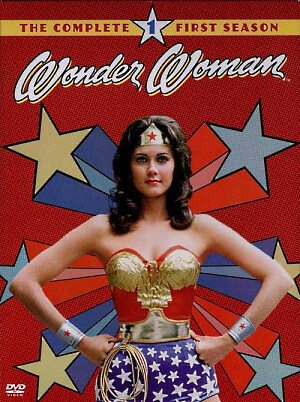
Wonder Woman

Wonder Woman is a woman from Paradise Island, an island that has been forgotten by the rest of the world, and by time itself. Wonder Woman and the women on Paradise Island are supposedly amazons from ancient Greece. They have super human strength and speed, the speed is used in an activity called bullets and bracelets where one person shoots a gun and the other uses their special bracelets to knock the bullets away. How a race that has been isolated for thousands of years not only knows what a gun is, but got a hold of one and developed a weird defense against it is beyond me. Wonder Woman is the daughter of the queen of the amazons, next in line to be exact.

The story begins with a German plot and American retaliatory actions during WW2. An officer, Steve Trevor, from the US army's plane goes down over the ocean, right by Paradise Island, and he washes up on its shore. Wonder Woman takes it upon herself to return him to his homeland (as there can be no men on Paradise Island) and returns him in her invisible jet (also.. how an ancient civilization managed this I'll never know). When she's there she eventually learns of the Nazis and decides that she had better stay where she is and help defeat the Nazis. She creates an alter ego for herself named Diana Prince, and works as the secretary of the man she saved earlier.

From that point on Wonder Woman find out about Nazi schemes through the war department office or when she's out with Steve, and then Wonder Woman will miraculously appear when there's trouble. As for the role gender plays in her superiority, Wonder Woman has a huge naiveté. She doesn't know anything about the present day and this often humbles her or gets her into compromising situations. From a not-so-accepting-of-female-independence perspective, it was ok that she was physically superior to men because she was really ignorant and still needed male guidance. This kind of thing came up several times in the show and was kind of annoying. For a princess she wasn't exactly regal. On the other hand, she was pretty pro-feminism for the time.

The pilot was very long and almost boring, with several parts dragging on and on, but the actual show is very watchable. It's not my favourite superhero tv show, but it's pretty good.


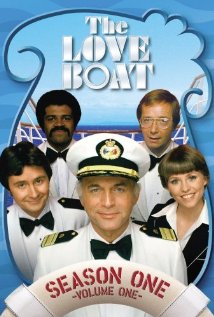
Love Boat

This is a really good show from the '7o's/ '80's about the romances that take place on a cruise ship. Each episode features three storylines about three different couples and the troubles they're having in their romantic lives.

The couples are usually passengers on the ship so we never really have a continuous storyline, but we do have a steady crew that we meet each episode and slowly get to know better as the show progresses. When watching this for the first time I was surprised to find how relevant it was. It may have been my prejudice of the time, but I wasn't so sure that what I was sure was to be cheesy romance plots from the '70's would be able to stand the test of time. However, most of the stories are still plausible... even though we may use different language today to describe it.

What I love about this show is the guaranteed happy ending in a short amount of time. Actually, you get three for the price of one. Usually if you want that happy ending feeling you have to wait an hour and a half and you probably have to go through a couple of unhappy scenes to get there. With this show however, there isn't enough time for a lengthy unhappy scene, especially with two other stories to share the space. There's just enough time for one problem to arise and be solved. And you get three happy endings every time!


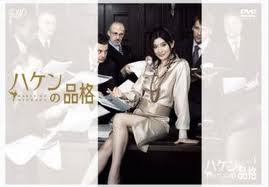
Haken no Hinkaku (Haken's Dignity / The Pride of the Temp)

In Japan there are apparently two kinds of workers that allow offices to function smoothly. There are the full-timers, the salary-men Japan is so well-known for, and there are the temp workers, called haken in Japanese. As one would expect, temp workers are not regarded with as much  respect as full-time workers, and this show plays with that dynamic.

There are two main characters in the show. One is the narrator, Mori Miyuki. She is just entering the haken profession and isn't that good at it. She has no skills, no friends, and no confidence. This show is partly about her personal growth. The second main character is named Oomae Haruko, and she is a class A haken, which means she is extremely good at what she does and is very qualified. We never hear her perspective or thoughts as the show progresses, but see her only as an outsider would.

These two enter into a 3- month contract at the same time with a company. Mori is shy, nervous, and extremely willing to please, which is closer to what full-timers would want or expect from a haken. Oomae on the other hand is the extreme opposite. She refuses to work overtime (a big deal in Japan)  and refuses to extend her contract. She only responds respectfully to her boss, either ignoring everyone else or curtly telling them to get back to work, or to do their jobs better. All of this is put up with however because she is the best at what she does. The two haken are put into the newly formed marketing department with a very good-hearted, well-meaning manager. The manager's friend however, in the sales department, seems really upset with Oomae's attitude. He goes out of his way to prove that full-timers are better than haken, and that he is better than her. He obviously ends up having a crush on her.

Each episode discusses some of the injustices haken's face... it's not an overtly political show by any means, but the premise is based on injustice. In every episode there is also some huge catastrophe that can't be solved by anyone in the company, and Oomae always comes to the rescue with her many random qualifications, like midwifery, or elevator technician. As the show progresses we discover that Oomae is the way she is because of a past event in her life, and she only treats full-timers with such perceived disrespect because they disrespect hakens, even though hakens do the work full-timers are unable to or don't finish.

When I was watching the show, I didn't really think Oomae's attitude was so very bad. Japanese society is really concerned with group activities and togetherness, for example when work is done, sometimes all of the employees of a department will go out for drinks to strengthen their bond, or if one person has a problem, everyone on the team will try ease the burden.. because as a group it's everyone's concern.  Oomae's attitude was more North American in that she was only concerned with working exactly the amount of hours she was getting paid for. She also didn't want to see her peers outside of the office and was mercilessly disinterested in her fellow employee's troubles. She of course always ended up playing an important role in ending their troubles as well. In the end, everyone is affected by Oomae and she changes many people's lives, especially Mori's. Oomae also changes a bit, but the change isn't as apparent as it is in the other characters.

Japan's a pretty hierarchical society and it's interesting to see how this plays out in a professional setting. The show is only 10 episodes long and is worth the watch.

You can watch the first episode here. The first minute is just explaining the haken situation, and then we meet Oomae for the first time backpacking in Spain. If you want to skip right to the show's 'intro' it's at 10:18.

Saturday, 7 January 2012

The Castle of Cagliostro (1979)

This is a movie about two thieves who target an old and wealthy castle for their next gig where they think a counterfeit money operation is happening.

The main character is named Lupin, a charismatic, clever master thief with almost as many tricks up his sleeves as batman. Lupin takes his partner to the Duchy or Cagliostro where the rumoured counterfeit bills are supposedly being made and meets Princess Clarisse. When Lupin first meets her, Clarisse is in something of a predicament and is trying to escape a group of men. Lupin is oddly drawn to her and bumps into her again later, discovering that she is being forced to marry a count. As it turns out, the count is also at the center of the whole counterfeit operation. In addition to the counterfeits, there is also rumoured to be a hidden treasure somewhere in the castle of Cagliostro, a treasure that may be tied to matching rings both the count and Clarissa wear, and the count wants dearly to find it. Lupin gets into more and more trouble with the count as he tries both liberate the princess and wrest the mysterious treasure from his power, after he finds it of course. In addition to all this, there is a police officer on Lupin's tail, hoping to catch him and throw him into jail for all the past offenses he's committed.

I first heard of this movie a while back, but delayed watching it. It was directed by Hayao Miyazaki before Studio Ghibli came together, so I knew there was a good chance the story would be good, but the animation style really isn't my favourite, and the first five minutes didn't really grab me. Fortunately, the story is  done well enough that I was able to look past the animation style and appreciate the story. Once the plot gets going it really draws you in. It's intricate, but fun. There's mystery, suspense, action, and just a hint of romance. A hidden gem, don't pay much attention to the packaging, this one is worthy of a watch. The dubbed version is currently on Youtube.


Friday, 6 January 2012

Child Bride (1938)

This movie was made as a sort of social statement against men marrying girls, which was apparently common practice in some places. The story takes place in a hillbilly community up in the mountains somewhere and the local teacher who was born to the town but went away for school, Ms. Carol, is determined to stop child marriage.

We are first introduced to Jennie and her family. Jennie is a young girl around 9 or 10 years old who lives with her mother and father. She does her chores, likes school, and plays with her childhood sweetheart Freddie whenever he happens around, which is often. Jennies father is a good man who runs a local logging or milling business. His partner Jake on the other hand, is a mean sort and bullies those weaker than himself. One day, Ms. Carol goes around a little too vocally trying to convince people that child marriage is bad and Jake gets together some of the other men in the village to send her a message. They kidnap her at night and drag her into the mountains to what I assume would be tar and feather her, but Jennie's father steps in and stops them. Ms. Carol has a fiance back in the big city who happens to be a lawyer and though he desperately wants her to marry him, she will not leave this town until her mission is complete, and she asks him to try to get a bill passed that will end child marriage.

In the meantime, Jake cooks up something to get back at Jennie's father. He gets some of the other men in town to say that Jennie's mother had been fooling around with Jake. The father of course gets drunk and mad and goes home to beat his wife and pass out. Jake slips in and out when the ruckus dies down and stab's Jennie's father, killing him. Jennie comes home to find her mother huddled in a corner and her father passed out, but when she goes to put him to bed she finds that he's dead. Jake walks in at that moment and says that he'll blame Jennie's mother for the murder if she doesn't let him marry Jennie. Will Jennie have to marry the man? Will Ms. Carol be able to do anything to stop it? Will Freddie be forever without Jennie?!

This movie was pretty good. The acting was alright, the message was clear and the story was plausible. It was made in the 30's so it's not as graphic as something that might be made today, but the movie doesn't even suggest any sort of sexual harassment. It's more ideological than physical in making it's statement. I mean there is still the engagement between Jake and Jennie and it's suggested that the two will have relations when they marry, and that others have before them. And there of course the domestic abuse, but there is no suggested man on girl action taking place, so there's no worry on that account.

 
This is the trailer but the whole thing is actually on youtube so you can watch it there.

Sunday, 1 January 2012

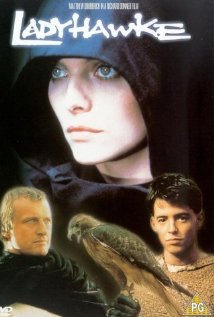
Ladyhawke (1985)

This movie was recommended to me as something on par with The Princess Bride and Legend, and I like both of those movies so I checked it out... but it's an unknown for a reason.

The story is about a pickpocket who breaks out of an inescapable prison. When he's a good distance away, he brags of his escape at a local inn, not noticing the prison guards also stopping for a drink. Before they kill him, he is saved by a mysterious cloaked stranger, who later forces the boy to accompany him in hopes of being lead into the city the pickpocket just escaped from. The cloaked stranger always has this hawk with him, and every night the stranger disappears as does the hawk, and a strange woman appears, sometimes in the company of a wolf. The pickpocket discovers that he has stumbled upon a tragic love story... and it is eventually up to him to set things in motion to reunite the estranged lovers.

Matthew Broderick plays the pickpocket, and he really wasn't that good in this role. I've only ever really liked him in Ferris Beuller.. and maybe he just lucked out with that role. I felt that he was too superficial, trying to hard to portray some happy-go-lucky ne'er do well. Not that all of the actors in this film were amazing, but if they had chosen someone else the film might have been better.

The plot had potential, who doesn't like a good tragic romance? But I felt like they could have done so much more with the plot than they did. They could have gone into more detail about the lover's past. The male lover's motivations could have been clarified. I understand the angle they were trying to get, but he came off as a selfish, almost petulant individual, and they could have definitely gone into Michelle Pfeiffer's character in greater detail. They seemed to more note her beauty or tell stories about her, but we aren't able to get to know her as well as we do some of the other characters... which is unfortunate as she's central to the plot. When the time came for the curse to be lifted, I didn't feel enough of a connection with the pair to care whether or not they were free or doomed.

Another thing that dates the movie a bit is the main character's ongoing dialogue with God. I don't really mind this personally, but I don't think something like, bring God into the everyday, would be likely to show up in theaters today. Society isn't as accepting of religion as it used to be. It's tolerant, most of the time, but leans more toward the absence of religion than it's presence.