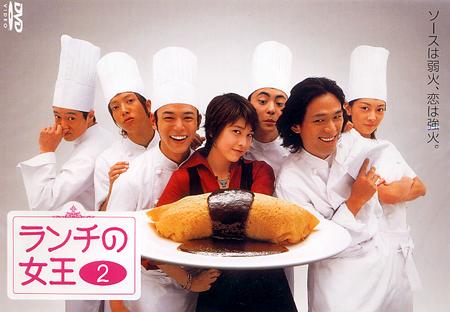
This is a Japanese drama about a young woman who really loves food. Her life isn't the best. She works at a cafe, really just putting the hours in, but really doesn't care about the work. What she does care about however, is when lunchtime comes around. She will do whatever it takes to take her lunch on time, and when that time does, she goes on a hunt for the best lunch in town. She even keeps a book full of notes on the places she's tried. It's just another day for Natsumi when, on her very precious lunch break, a strange man pulls her into an alley and begs her to come home with him, pretending to be his wife. He says that his father is dying and he wants to see him one last time, but he'll be so disappointed if he doesn't bring home a wife, she would only have to pretend for the day, etc. Natsumi is having none of it... until the guy says that he will give her the best omurice (rice omelet) that she's ever tasted, so she goes.
As it turns out, this guy's family runs a restaurant, and he's just back to con them out of some cash. Because Natsumi took pity on this guy, she lost her job at the cafe, and without that has no way to pay for her apartment. In addition, she has a very strong love for food, and fell in love with the restaurant's flavour. So she goes back to the restaurant, claiming that as their brother's fiancée, they have to help her. She will work at the restaurant until that guy comes back. At first, the brothers are understandably having none of it. But they slowly warm up to her, especially Jun, who develops a crush on her. She tries her best to do her job well, and she eats with such gusto that they can't help but enjoy her presence. As she lives with them, she learns more about the family and their struggles to continue the business and preserve their unique flavour. At the same time, Natsumi runs in with some people she used to know, people in a bad crowd, and she has to juggle the two worlds. Will her 'fiancee' ever come back to fix the mess he made? If he does, will he have to fight off his younger brother for Natsumi's supposed affection? Will Natsumi be able to hold on to this world she find increasingly dear to her? Watch to find out!
I liked this drama. The characters are all fun and energetic and genuine. As with most of these shows, they really try to capture that 'artist' essence and the importance to try hard and give it your all, which can be heartwarming. The biggest thing though, is that this show makes me hungry. I wouldn't be lost walking into a Japanese restaurant, but I've never been to Japan and have not tried 'authentic' Japanese food. I've never had an omurice, but watching this show... I want one.
This is a film from the studio Ghibli, but unlike the other more famous films from that studio (Spirited Away, Princess Mononoke, Ponyo, etc) this one wasn't a Hayao Myazaki production. It does however moderately borrow his style, so it has that appeal. The story is based on the book titled, The Borrowers by Mary Norton, and indeed, the characters share the same names as their novel counterparts.
The story is about a young girl named Arrietty who lives with her mom and dad in a huge house in the countryside. This house is much more large for Arrietty and her parents, because they are all tiny people, about the height of a mouse. Arrietty is a borrower, a small person who lives in a regular bein' (human being) sized house, and borrow things from around the house to survive. If anyone finds out they're there however, they must leave for their own safety.
The story begins when a young human boy comes to the house Arrietty lives in. Sho (or Shawn in the English version), is a terminally sick boy whose mother was raised in that house. He was moved out to the country for the sake of his health, but he's a very lonely boy. Arrietty on the other hand, is ready to go out on her first borrowing mission, but she has some bad luck and Sho sees her! This is a big problem for Arrietty and her family because it means they must now leave the house. Sho of course is delighted that there might be little magical people living in the house and tried to find Arrietty and get close to her. We get to see a little bit of Arrietty's world, Sho's attempts to interact with Arrietty, throw in a suspicious housekeeper who seems to have a burning desire to destroy what she suspects to be little thieves in her house, and that's pretty much the movie.
I'm familiar with this story. I've read the novel and seen the 1997 version of The Borrowers (which I slightly prefer to this representation by the way), so I had a pretty good idea of what to expect and had my own expectations going in. But the film wasn't a disappointment. It was a little slow-moving at times, but the pace was consistent and never did I feel that the story was stagnating. It was more of a charming film than a comedy or drama, more exploratory. I do have to say however, that it was not a top-notch film. Though it used the same style of animation and storytelling as in the Myazaki films, the mood of the film was somewhat stagnant in comparison and lacked that air of magical possibility. In comparison with the 1197 English version, it was a very slow-moving interpretation of the story. The parents are also kind of flat personalities that rely on stereotype rather than demonstration to let you know who they are, and that could be said about almost every character except for Arrietty herself. However, that said, the movie was a nice little film overall and worth a sit through.
I've never thought to do a review on this movie, but what with the Hunger Games hype, I thought I'd go hipster and bring up this movie that came out over 10 years ago that has the exact same premise.
We enter the film with the narrator explaining that this is an unsettling time in Japan. The youth is out of control and the government doesn't know what to do about it, so to combat these crazy, moral-less adolescents, the BR act in introduced. The BR (battle royale) Act is a nation-wide lottery where all grade nine classes are automatically entered. If a class is selected, that class is transported to a deserted island where, in the span of at the most, three days, one student must kill all of their classmates and be the last one standing to 'win' or deadly necklaces they are forced to wear will explode, killing everyone. The students are each given a bag of provisions to last them three days as well as a mystery weapon, the weapon can either be good, or very ineffective.
The main characters are named Shuya Nanahara and Noriko Nakagawa, but several of the students play significant roles in the film and I believe that if you read the novel (from whence the film came) there is technically no 'main character' as anyone could die at any time. As an example of some not so good weapons, these two get a pot lid and binoculars for weapons, while others get guns and swords and the like. We are introduced to several of the students and their relationships with each other. For the students we do get to know a bit, we also get a bit of a back story on them as well, explaining certain relationships or characteristics. There are also two transfer students who are wild cards, and throw everyone off a bit. We get to see several different strategies on how different characters react to the situation. Some kill themselves, refusing to play all together, some try to fight the system, others try to gang up (though this would probably prove to be problematic if they did indeed kill everyone else), you of course have the crazy ones out to kill as many people as they can, and there are those just trying to survive till then end without killing or being killed.
What I like about this film, besides the lord-of-the-flies-esque gore, is that this movie is actually just like any other teen, high school drama. We get to hear about romances, jealousies, clique wars, etc., but instead of it ending peaceably with a sugar-coated happy ending, they kill each other. One of my favourite scenes is where a group of 'best friend' girls are in this lighthouse together, and after one of them sneakily tried to kill Nanahara with her weapon, who they have injured upstairs, she accidentally kills one of her buddies. They of course all break out in a shrieking, adolescent, immature argument, blaming and accusing each other for what happened. Under any other circumstance this kind of scene would annoy me so much... but then they all kill each other and die. It's so good.
There is a bit of gore in this and there is a disclaimer at the beginning stating that upon its release, children under 14 years of age were prohibited from watching it... but it was made in 2000 and I feel that our media has progressed enough technologically for this to not be as disturbing as it might have once been.
This is such an epic film that I recommend it to everyone. There really is something for everyone, and everyone over a certain age is sure to get some sort of enjoyment from watching it. It's like Lord of the Flies meets Kill Bill meets Sixteen Candles... in Japanese. On the DVD (it was just legally released for the first time in North America recently) it says this one of Quentin Tarantino's favourite films, which gives you kind of an idea... but it really doesn't need the recommendation. If you have not already seen this, you should go watch it. Now.
This is an animated movie about an agency that has developed a device that allows an agent to go into a client's dreams and provide therapy. Things start to get strange however, when the dreams start getting out of control and begin trying to take over people's waking lives, even influencing the to kill themselves. Kind of sounds like Inception (2010), doesn't it. Doesn't it. Well, it's not exactly like Inception, but there are several similar themes.
Paprika is the dream form of a young woman whose job it is to help clients work out psychological problems by participating in and interacting with their dreams. The company she works for has developed a device that allows the company to see the client's dreams, and interact with them in their dreams, but this new technology is still in the trial period and has not been sanctioned by the government yet. The government decides that these devices are too dangerous to be on the market, but before they can remove these products, one of them is stolen, and is being used to drive some of the scientists to insanity, and even death. The dream world slowly begins to seep into the real world, and it's up to Paprika to overcome the obstacles put in her way to find who is behind this madness, and to stop it before it's too late.
This is an amazing movie. The plot is interesting of course, but I would recommend that you watch this more for the visual and aural experience, and I guarantee that that will be what you will take away from the film, and what you'll be talking about with your friends (if you are a loser like me and talk about films with your friends). Watching this film is like watching a moving canvas. Because it takes place in the dream world (and because it's Japanese) weird is ok, which makes for an amazing visual experience. I can't stress this enough, you'll be tripping even if you're sober. There are one of two disturbing scenes, the film is rated R, but if you're a mature adolescent or older, I'm sure you'll be just fine. The soundtrack is also amazing. I don't usually go out of my way to enjoy a soundtrack if the film is not a musical, but I listen to this soundtrack on a regular basis. It's high energy and quirky.
The movie starts off kind of slow, but once it gets going you'll be unable to tear your eyes away... maybe in a good way and maybe in a bad way... but you'll remember watching it either way.
In Japan there are apparently two kinds of workers that allow offices to function smoothly. There are the full-timers, the salary-men Japan is so well-known for, and there are the temp workers, called haken in Japanese. As one would expect, temp workers are not regarded with as much respect as full-time workers, and this show plays with that dynamic.
There are two main characters in the show. One is the narrator, Mori Miyuki. She is just entering the haken profession and isn't that good at it. She has no skills, no friends, and no confidence. This show is partly about her personal growth. The second main character is named Oomae Haruko, and she is a class A haken, which means she is extremely good at what she does and is very qualified. We never hear her perspective or thoughts as the show progresses, but see her only as an outsider would.
These two enter into a 3- month contract at the same time with a company. Mori is shy, nervous, and extremely willing to please, which is closer to what full-timers would want or expect from a haken. Oomae on the other hand is the extreme opposite. She refuses to work overtime (a big deal in Japan) and refuses to extend her contract. She only responds respectfully to her boss, either ignoring everyone else or curtly telling them to get back to work, or to do their jobs better. All of this is put up with however because she is the best at what she does. The two haken are put into the newly formed marketing department with a very good-hearted, well-meaning manager. The manager's friend however, in the sales department, seems really upset with Oomae's attitude. He goes out of his way to prove that full-timers are better than haken, and that he is better than her. He obviously ends up having a crush on her.
Each episode discusses some of the injustices haken's face... it's not an overtly political show by any means, but the premise is based on injustice. In every episode there is also some huge catastrophe that can't be solved by anyone in the company, and Oomae always comes to the rescue with her many random qualifications, like midwifery, or elevator technician. As the show progresses we discover that Oomae is the way she is because of a past event in her life, and she only treats full-timers with such perceived disrespect because they disrespect hakens, even though hakens do the work full-timers are unable to or don't finish.
When I was watching the show, I didn't really think Oomae's attitude was so very bad. Japanese society is really concerned with group activities and togetherness, for example when work is done, sometimes all of the employees of a department will go out for drinks to strengthen their bond, or if one person has a problem, everyone on the team will try ease the burden.. because as a group it's everyone's concern. Oomae's attitude was more North American in that she was only concerned with working exactly the amount of hours she was getting paid for. She also didn't want to see her peers outside of the office and was mercilessly disinterested in her fellow employee's troubles. She of course always ended up playing an important role in ending their troubles as well. In the end, everyone is affected by Oomae and she changes many people's lives, especially Mori's. Oomae also changes a bit, but the change isn't as apparent as it is in the other characters.
Japan's a pretty hierarchical society and it's interesting to see how this plays out in a professional setting. The show is only 10 episodes long and is worth the watch.
You can watch the first episode here. The first minute is just explaining the haken situation, and then we meet Oomae for the first time backpacking in Spain. If you want to skip right to the show's 'intro' it's at 10:18.
This is a high school drama about a girl named Mei whose parent's die. After their death she discovers that her estranged grandfather is very wealthy and she will inherit his empire, but first must attend a fancy all-girl reform school to become a lady. This school isn't just any school though. There are no desks, but rather cushy arm chairs and side tables and the campus is a third the size of Tokyo, but the weirdest thing of all about this school is that all of the girls must have butlers.
Mei is sort of resistant at the thought of becoming like these weird people, but eventually finds a reason to stay despite her reservations. Of course there are several people who are against her being there and make life hard for her. One girl in particular, the girl who has earned the highest rank on the lady- scale in the school, turns out to be her rival (in more ways than one), and even after she wins over some of her classmates, it is this adversary who is the real trial for Mei. The girl- butler dynamic is important to the plot. We learn as we watch that being a butler isn't just about waiting on someone hand and foot, but that there is a special bond between master and servant, and that the servants choose to serve.
I thought overall that the drama was interesting in theory, and the story line was well done, but the heroine was kind of pathetic. She was always whining or moping about. When she had a problem she would just stand there dumb-struck until someone saved her or until it was almost irrelevant for her to step forward. I also didn't like the actress who played her. She has one of those faces that seem to always be frowning, or smelling something disgusting, and yet her character was supposed to draw people to her and see how amazing she is. For the most part the characters weren't extremely attractive, but in addition to her unattractiveness, she couldn't act. If they had chosen a different actress to play the heroine this drama would have been much better. As it is though, it's still worth the watch.
The whole thing is actually up on YouTube for the time being, so knock yourself out.
This drama is about a girl of questionable femininity according to Japanese culture who is forced to live with her manager during the summer of her first love (that love of course not being the manager).
The story opens up in the office building of a successful interior design company. We see the employees hard at work, all fashionably and professionally dressed of course. After work a group of female co-workers go out on a group blind date. To encourage some of the younger women who aren't currently in a relationship, the more experienced women say that at least these women are out trying to find a man, unlike an undesirable form of womanhood which they call 'himono- onna' or a 'dried up fish- woman'. A woman who has lost her womanhood. And here we are shown the main character Hotaru. A dried up woman is someone who doesn't go out on the weekends or a night, but prefer staying home wearing sweat pants, drinking beer, and tie their hair in a knot on the top of their head.
By day, Hotaru dresses like a professional and 'normal' woman while she's at the office, but when she gets home to a very messy apartment, she turns into a 'himono onna'. Her manager is going through a separation with his wife and was kicked out of his home, so he decided to go back to his parent's old house to live. As it turns out, his father gave Hotaru permission to live there, so the two decide to try living together.. even though the manager is appalled at Hotaru's himono-ness.
Meanwhile at work, a new and attractive designer returns to the company from working abroad and Hotaru is struck by his handsomeness, but of course doesn't do anything to try to get close to him. One day she went to oversee a project and fell asleep in a chair. The new guy, Teshima, comes in and seems to be struck by her and gives her a kiss, which wakes her up. She's startled and makes a quick escape, but from that point on develops a severe infatuation for Teshima. Another woman at work also has her eye on Teshima, and she is much more lady-like than Hotaru is. Hotaru is clueless about love, but with the help of her manager and a few comments from her other coworkers, she does her best to secure her love and become a woman!
I really enjoyed this drama. It was funny and dramatic and I really enjoyed the main character. However, going into this I was of course somewhat conflicted as the subject matter was suggesting that a woman is only a woman if she is attractive and out trying to get a man. I think it's no secret that the west sees femininity somewhat differently than the east does... and yet it's not so different as you might think. In the west it's currently popular for girls to wear yoga pants like normal pants, but yoga pants are in fact just another type of sweat pant. The top knot/ samurai knot/ get my hair out of my face knot is also really popular and if girls don't wear it out, you know that most wear it at home, and it's considered cute. But at the same time, these girls are still trying to be attractive, for what purpose? To attract men. The western equivalent of the 'dried up woman' might be a tomboy or a woman who doesn't care about men and put's no effort in her appearance, maybe wearing no name, unattractive clothing. In the west, this type of girl is seen as the opposite of the ideal type of girl... the one who wants a man. The difference between the two might be that in the west the 'dried up woman' is still considered a woman, albeit an unattractive one, while in the drama Hotaru is told that she is no longer a woman. In the end, Hotaru doesn't end up changing her lifestyle and people just accept her as she is.
One of the things I enjoy about watching Jdramas is that there isn't always the same pattern when it comes to love stories, so you don't actually know who the heroine will end up with until later episodes... unlike what happens with western movies. In your typical chick flick you know within 10 minutes of watching the movie what will happen in the end, because they all use the same pattern, but in dramas you never really know. Sometimes they don't end up with anybody at all.
* Spoiler* What I really enjoyed about this series is that we get to see a full relationship, and then get to see that relationship fall apart. The show sets up those characters as the main romantic couple we should be rooting for in the series, but then makes their dates feel awkward, and breaks them up. I love finding stories about heartbreak because it's not a popular topic. We love the happy ending stories so much that very rarely in the west do explore the idea that sometimes what we think is love isn't love, and that's painful. I also like finding stories where the 'unnoticed best friend who really loves her' character gets the girl. I thought this drama did a great job with both of these ideas and tied them in together well. * Spoiler*
This story was well done and gives the audience something to think about in terms of what it means to be strong and what it means to grow. Worth it. And the girl is cute.
This is a Japanese television drama about a young girl who has an incurable degenerative disease, and the boy who falls in love with her. It's based on a true story, the illness part. The actual girl Aya published a book for other with her disease, to give them hope.
The main character is a 15-year-old high school girl named Aya Ikeuchi. She's the ideal girl in many respects, she is very kind, hard-working, and optimistic. She's on the basketball team, has many friends at school, and has also caught the eye of one of her upper-classmen, so potential romance there. Just your typical Japanese high school girl.
Then one day as she is leaving for school, she takes a pretty bad spill and splits her chin on the concrete. The doctor takes her mother aside and tells her that the fall was not ordinary, and that Aya had a rare disease that would slowly make it harder and harder for her body to function on its own. Stealing away the power she had over her own body. The mother tries to keep this from her as long as is possible, but starts to notice that Aya is having difficulties with everyday activities, like misjudging the space between objects, or being unable to use chopsticks.
At the beginning of the first term of high school we are also introduced to a young man, Haruto Asō , who is in the same class as Aya. He wasn't even going to take the entrance exam to the school, but fate would have it that the day he met Aya, he was sort of forced into taking them. Haruto isn't exactly a delinquent, but at the beginning of the story he seems to have a sort of disregard for everything happening in his life. One day he happens to see a web page Aya was on and discovers her illness. He starts to pay more attention to her and slowly begins to fall in love.
The title of this drama sounds really cheesy, and I almost didn't watch it the first time I heard of it, but the show is oddly true to its name, and not cheesy at all! One of the things that gets me every time I watch one of these is how good the Japanese are at these emotional roller coasters. It doesn't matter if it's romance or action or tragedy, you'll be enthralled, maybe even to a heart-wrenching degree. This one in specific, the tragedy/ romance genre. You don't get too many of these in modern Western film, the only two that come to my head immediately are Butterfield 8 and A Walk To Remember. It's not as scarce in Japanese television, which is alright I guess because they do it justice. I cried the first time I watch this, maybe for 3/5th's of the series, and that's a big deal for me. There are is one, maybe two movies that make me cry, I take pride in the fact that I don't cry easily when it comes to film, but this one had me balling. Sometimes when watching tv shows or movies from other cultures, you'll have to be understanding with some of the content. The culture's different and you might not understand all of the references, but the emotions are universal. You'll have to watch this online if you want to see it, and you'll have to put up with fan subs, fan made subtitles, but it'll be worth it.
Here is a trailer made by a fan of the show with some scenes
This movie is a few years old and was a straight to tv production as far as I can tell. And seeing as how I can't seem to find it anywhere else, I would assume it was only on for those couple of runs that I saw it... but it was one of the best films on how the Japanese were treated in Canada during world war 2.
The story features 2 families, the Kawashima family and the Parnham family. When world war 2 took place, the Kawashima family was uprooted from their lovely home and successful business in Vancouver, British Columbia, and forced to move to a low-income mining town. This came as something of a shock to the family because though Mr. and Mrs. Kawashima were not born in Canada, their children were and Mr. Kawashima served in the Canadian army during world war 1. One of the very vibrant images I have of this film is watching the Japanese family move into this little shack of a house from the perspective of their neighbours, the Parnhams. The family is obviously wealthy. The women wearing fur coats and have fashionable hair and make up, the men in suits, the ornate furniture and belongings they have brought with them to their new home, and how all of this so obviously clashed with the poverty-stricken area, the dirt roads and floors, and even the shabbiness of the cart carrying their things.
The eldest daughter of the Japanese couple, Aya, ends up becoming a housekeeper for the Parnhams. Ed, the husband, is open- minded about their new neighbours, but his wife Peg is more skeptical and treats Aya like a maid. By the end of the movie though, Peg has warmed to Aya and she becomes one of Peg's closest friends. The Parhnams have a young daughter, Marg , and she is very curious about the new neighbours. She starts hanging around their house and asks her already nervous mother questions about what she sees there. She completely immerses herself in the culture of the new family and the other Japanese people there. By the end of the film the family discovers that the government sold their house and business without their consent, and to add to the insult they are to be deported back to Japan, even though they are Canadian citizens and their children have never been to Japan. The final scene in the movie has the Kawashima family in the back of a truck, being driven away and Marg running after them in a little Kimono.
This movie is a really good film, both in terms of its historical content as well as in terms of it just being a good film. The acting was well done and I could relate to all of the characters. I was probably in elementary school when I saw it, but I really enjoyed it and I think that the movie's ability to hold my attention and imprint itself in my memory says something about the storytelling.
I cannot find a movie cover for this anywhere, it's not on amazon or any other site I can find, so here is the imdb page http://www.imdb.com/title/tt0114892/
I'd heard of this movie and seen it around on and off for several years, but the clips I'd seen and the description turned me off, so I didn't watch it despite having heard good things about it. After seeing it however, I don't know why I waited so long! The movie is about two guys who want to interview a famous actress for the documentary they're doing on her life. Clips of the movies she has been in are featured throughout the film to tell the story of her love for a man she doesn't really know. This sounded extremely boring to me. The pacing of the movie isn't fast and exciting either, but more of a slower building up to the climax, so if one were to fast forward through to see segments of various scenes... well it just looked boring. But, the movie is actually really good.
First of all, the art is amazing. A lot of attention paid to detail and it's a pleasure to watch purely from an artistic perspective.
So the story is about two guys who interview a famous actress about her life, and she tells this story through movies she's been in. Basically when she was young she met a wounded rebel in the streets and hides him from the police for a night. When she goes to see him in the morning he's gone, but he left a picture of her that he drew saying something like 'until next time'. So she sort of falls for this man and then obsesses over him for the rest of her life. She gets an offer to be an actress and accepts because the job she was offered took her to where the guys escaped to. So we find out that her success as an actress stems from her desire to find this guy. And this sounds superficial and weak as a motivation to do something with your life, kind of playing off the stereotype that a woman needs a man to complete herself, which is why I like this movie so much. When a typical North Amercian thinks of Japanese culture, or for some people Asian culture in general, they think of the stereotypes of weak- willed, submissive women because of how the media portrays them and such, but this movie subtly twists that stereotype on its head. The girl spends her entire life chasing after this guy and during many parts in the movie I wondered why she doesn't just give up on the guy and live her life for herself. At the end of the movie though ... I guess spoiler alert, but if I'd known this sooner I'd have watched it sooner... she tells the interviewer that it didn't matter to her if she ever actually caught up with the guy. In fact if she did catch him she would probably get bored of him because it was the chasing that she lived for. And this is like anything in life. If you chase a man or a job or even an ideology of some kind, the journey is the important thing, meaning that she is in fact living for herself, even though from a supercifical or incomplete understanding of her situation, it seems to be otherwise. That made the movie for me. So I liked it.
This movie is a classic. The animation is spectacular and the story very well done. I happen to be somewhat into Japanese culture as of present, but before I was so into it, and people who I know now who are not into it, sometimes Japanese media goes over their heads. The cultures are kind of different and place importance on different things and when a person used to seeing one kind of story or moral repeated over and over in different ways sees something else... well they may not immediately appreciate it (an example of this would be how at the end he doesn't end up with the girl). This happens in almost every western movie because we are very focused on the 'happy ending' fairytale, validating the storyline with the 'kiss at the end', but that doesn't happen in all cultures). However, I found Princess Mononoke to somewhat transcend this confusion, because the story is so relatable and well told. I found it to be so when I first watched it, which would be late elementary school, and feel this way even more now.
The story can be translated in many ways, but the general message I got out of it was the modern attempting to erase tradition. The people of Iron Town worked hard to destroy the forest because by doing so they could earn a living in the new world making iron. The only way they could do this however was to cut down the forests, which meant that they would have to kill the gods from the old world, who were already dying out. The thing is that the Lady Osono is painted in something of a bad light as she is cutting down the forest and killing the gods, but she is an amazingly strong humanist. She's a proactive woman in a time and place where women weren't liable to have that status (the status might help to paint her as a 'bad guy' however, because even though we are making progressions, many people are still very sexist... I would bet you that if not you yourself, someone you know thinks that women are by nature evil or devious... in 2008). So when looking at it in this light Osono is opting for humanity. She takes in lepers, she saves brothel workers from whatever fate they would face in brothels, etc. and yet she's the 'bad guy'. Interesting to note at any rate.
Ashitaka is a great protagonist. A pacifist to the end. He goes on his journey to find something to remove his curse. Not for selfish reasons I don't think, but to right the wrong. He's a pretty selfless person. At the beginning of the movie, the reason he got the curse was because his sister was in the way of the cursed boar, so he had to shoot it, but before that he was trying to talk to it and calm it's anger. This is basically how he acts throughout the movie. He tries to get things done without violence, but if it comes to it, he will resort to violence to protect himself or those he cares about.
I didn't really notice the environmental message when I first saw it. I was more focused on cultural loss. But recently, with the environmental bludgeon the media has been playing around with, I noticed just how 'for nature' this movie was. Traditionalism would of course take the stance against industry which would be a way to save the forest, so it makes sense, but I guess I just went into it too symbolically. It does have a pleasant environmental message however, better than a lot of other animated environmental movies.
This story portrayed the forced Japanese emigration during the WW2 period. Many many Japanese families were sent back to Japan because the government thought they could be used as spies, even though many of these people were born in North America.
The story is about a girl who goes to visit her grandmother. The next door neighbour is an older Japanese man and the girl goes over to help him with his garden every day. The garden is something she's never seen before, it has no flowers or plants, it's mostly rocks and has a pond with koi fish, which she feeds. Then one day her grandmother tells her that many Japanese people are being sent away, and she finds out that the old man is one of them. She sits with the old man watching the sun go down and promises him that she'll look after his garden for him. After a while a new couple moves in and tears up the garden, replacing it with a western style garden. The girl takes the fish and sets them free and a stone and when she gets home she starts a small rock garden of her own.
I thought this was a good way to relay the information in picture book form. It tells the reader what happened and lets them feel the sadness, but does it gently.