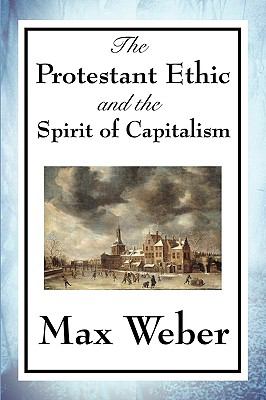
This book was somewhat difficult to get through because of the footnotes (I have trouble with footnotes), once you get over that though, it's a fantastic book. It discusses why the capitalist system we have now, and the morality we have now, is the way it is. We have all heard of the protestant ethic, yes? It is the idea that you must work hard, without receiving too much pleasure, for the sake of pleasing God. Working as hard as you can allows a person to 'most effectively' utilize the gifts God has given them, but they cannot take pleasure in the fruits of this because too much pleasure would result in the breaking of some sin, greed or sloth or what have you. But if you can't have fun with what you're working so hard to create, why work so hard? Because you are pleasing god, setting yourself up for the next life. Well this is wonderful for a historical reference, but we're very much secularized in society today so why does any of this matter? Well, Weber contends that a man named Calvin (yes Calvinism) took the protestant ethic and tied it to capitalism. Calvin took the protestant ethic, which was good because it got things done with little complaint from the workers, and connected it to the economic system by turning the idea of pleasing God into earning money. We can imagine the problems with this. If nothing else, there would be trouble behind the fact that what motivated people before was spiritual, and now we expect the same results because of different motivations. That's like using a car to float down a river instead of a boat. Ya cars go forward wonderfully, on the medium they were designed for.
So now we all ascetically put ourselves into our work towards the end of making more money. I'm not a history buff so I don't know if this is true or was just used as an example of how religion effected capitalism, but I don't really care as I can see the connections between the protestant ethic and our capitalist morality.
Weber calls where we are now the iron cage, kind of pessimistic, but he believes that now that we're in this position, we're stuck here. We can't get out of the mental state we are in now, which I don't necessarily agree with, but can see how someone could. If you leave the economic system today and do not movie to some isolated cabin in the woods, chances are you'll end up on the street. I think this is my favourite quote, it's right at the end of the book and sums up the final point quite well.
"No one knows who will live in this cage in the future, or whether at the end of this tremendous development entirely new prophets will arise, or there will be a great rebirth of old ideas and ideals, or, if neither, mechanized petrification, embellished with a sort of convulsive self- importance. For the last stage of this cultural development, it might well be truly said: Specialists without spirit, sensualists without heart; this nullity imagines that it has attained a level of civilization never achieved before"
An eye opener to say the least, but a really good read.
Showing posts with label philosophy. Show all posts
Tuesday, 1 September 2009
Fight Club by Chuck Palahniuk
This is an amazing book. If you've seen the movie there won't be any surprises, but the book goes more in depth into the concepts and such so the reader can get a firmer grasp on the ideas the author is trying to convey.
The story starts off with this guy who's going to these anonymous groups for people with terminal diseases, but he doesn't have a terminal disease. So right at the beginning of the book we have the main character searching out destruction as a way to solve his discontent. The cause of his discontent of course would be that he feels he doesn't belong within his own society, that his individual self has no presence when interacting with society as a whole. So the individual revolts against society, reasserting its authority over itself. And this would be the reason for fight club. what makes fight club so wonderfully appropriate as a beacon for the individual to rise up against society is that society finds the concept of fight club so abhorrent, it doesn't understand the logic. Society's morality dictates that we are all special individuals that are to cherished. We are all special individuals... something of an paradox, but as we all sway to society's rhythm we can see the logic. But if we take this statement apart and apply it to our own lives, because the western world believes this to be true, generation me as an example, and yet we are all alienated and desire/ are forced to be the same. One of the mantra's in this book was 'i am not a special snow flake' or something to that effect. By denying society's morality, the individual recognizes their discontent and counters it (of course in real life the contrasting extreme is no better than what caused the trouble in the first place, but one very much deserves the other... and its great for symbolic purposes:P). The members of fight club act in a way that society does not comprehend so that the individual can gain autonomy over itself, wresting itself out of the numbing grasp of society. This would manifest itself as destructive behaviour, both towards the self and towards the other, desiring the loss of the individual in a crowd, looking beneath the superficiality we create around ourselves to present as an image, and presenting something unacceptable in its place.
Besides the extreme need for society and the extreme need for the individual there is also the need for balance, hence there being three components to the novel. the aggravator, the aggravatee, and something detached from both. The aggravator would be society, whose desire is to quell individuality and can be found in characters that are 'normal' like the guy's boss, or the very motivation in each of our heads and within the scope of each character's awareness to conform to the bigger picture. The individual would contrast this in it's desire to rise up out of society establishing its autonomy over itself, and this can be found in the idea of fight club and those who believe in it's teachings. The third party would be able to see the benefits and flaws in both extremes, and that would be our narrator, or even the reader, and this person sees a need for both.. or a need for neither.
It was very symbolic, which I enjoyed, but if you're not the type that goes for symbolism... well it'll tap into your rebellion or something.. and it has the fighting (which is you reveling in the symbolism but denying it!). Great book though. I recommend.
The story starts off with this guy who's going to these anonymous groups for people with terminal diseases, but he doesn't have a terminal disease. So right at the beginning of the book we have the main character searching out destruction as a way to solve his discontent. The cause of his discontent of course would be that he feels he doesn't belong within his own society, that his individual self has no presence when interacting with society as a whole. So the individual revolts against society, reasserting its authority over itself. And this would be the reason for fight club. what makes fight club so wonderfully appropriate as a beacon for the individual to rise up against society is that society finds the concept of fight club so abhorrent, it doesn't understand the logic. Society's morality dictates that we are all special individuals that are to cherished. We are all special individuals... something of an paradox, but as we all sway to society's rhythm we can see the logic. But if we take this statement apart and apply it to our own lives, because the western world believes this to be true, generation me as an example, and yet we are all alienated and desire/ are forced to be the same. One of the mantra's in this book was 'i am not a special snow flake' or something to that effect. By denying society's morality, the individual recognizes their discontent and counters it (of course in real life the contrasting extreme is no better than what caused the trouble in the first place, but one very much deserves the other... and its great for symbolic purposes:P). The members of fight club act in a way that society does not comprehend so that the individual can gain autonomy over itself, wresting itself out of the numbing grasp of society. This would manifest itself as destructive behaviour, both towards the self and towards the other, desiring the loss of the individual in a crowd, looking beneath the superficiality we create around ourselves to present as an image, and presenting something unacceptable in its place.
Besides the extreme need for society and the extreme need for the individual there is also the need for balance, hence there being three components to the novel. the aggravator, the aggravatee, and something detached from both. The aggravator would be society, whose desire is to quell individuality and can be found in characters that are 'normal' like the guy's boss, or the very motivation in each of our heads and within the scope of each character's awareness to conform to the bigger picture. The individual would contrast this in it's desire to rise up out of society establishing its autonomy over itself, and this can be found in the idea of fight club and those who believe in it's teachings. The third party would be able to see the benefits and flaws in both extremes, and that would be our narrator, or even the reader, and this person sees a need for both.. or a need for neither.
It was very symbolic, which I enjoyed, but if you're not the type that goes for symbolism... well it'll tap into your rebellion or something.. and it has the fighting (which is you reveling in the symbolism but denying it!). Great book though. I recommend.
Thursday, 16 July 2009
Beginners Guide To Reality by Jim Baggott
I really enjoyed reading this book. It's a great metaphysical book for beginners and makes you question what reality really is. For the most part, the author goes about this using reason, but in the last part he goes a bit into quantum physics, not to put you off it of course!!! It's a great read, even if your not a philosophy major, it written in a very readable way. I would strongly recommend this!!
Thursday, 9 July 2009
Unbearable Lightness Of Being by Milan Kundera
I really enjoyed this book, it's one of those ones you have to think about. The story follows two couples, Tomas and Tereza and Sabina and Franz. These people are used to embody certain ideals and characteristics, and I interpreted their actions more as metaphor rather than just an act in itself.
I suppose one of the major themes in the book is expressed in the title, this idea of weight in association with how we interact with the world, and whether or not it is a good or bad thing to have. I understood the weight to be our ties to the world, our responsibilities. Like a sac we carry. The question is -is it better to have the sac full of stuff you may need or want with you or is it better to be unburdened? What I found helpful was that for the perspectives presented, the opposite perspective is presented to contrast, neither one being more right than the other.
Each of the four main characters had some sort of struggle they were attempting to overcome (which I loved reading about. There is nothing more enlightening and empowering than to watch someone overcome what discontents them). All of the struggles have to do with how the characters interact with those they know, which I saw to be a preference for either weight or lightness.
This is one of those books you could (and should) spend hours thinking about.
I suppose one of the major themes in the book is expressed in the title, this idea of weight in association with how we interact with the world, and whether or not it is a good or bad thing to have. I understood the weight to be our ties to the world, our responsibilities. Like a sac we carry. The question is -is it better to have the sac full of stuff you may need or want with you or is it better to be unburdened? What I found helpful was that for the perspectives presented, the opposite perspective is presented to contrast, neither one being more right than the other.
Each of the four main characters had some sort of struggle they were attempting to overcome (which I loved reading about. There is nothing more enlightening and empowering than to watch someone overcome what discontents them). All of the struggles have to do with how the characters interact with those they know, which I saw to be a preference for either weight or lightness.
This is one of those books you could (and should) spend hours thinking about.
Subscribe to:
Posts (Atom)