Thursday, 24 February 2011

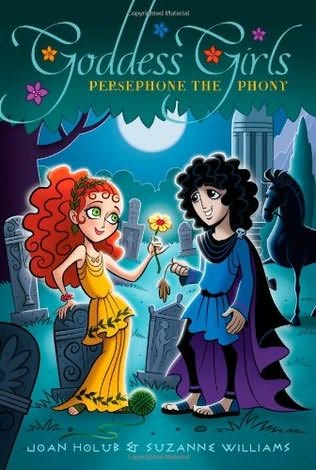
Persephone the Phony (Goddess Girls) by Suzanne Williams and Joan Holub

Goddess Girls is a cute series for young girls about goddesses from Greek mythology, namely Persephone, Athena, Aphrodite and Artemis. This is the first book I've read in the series and I was drawn to it because I've always liked the story of Persephone and Hades, and though the story is called 'The Rape of Persephone' I've always considered it to be more of a forbidden love story than Hades taking her against her will.

The goddesses in this series are 12, the supposed age of the potential reader and all of the gods and goddesses interact mostly at god- school, with Zeus as the principle. Persephone is a shy girl and always goes along with what her friends want to do or are interested in instead of saying what she would like to do, and because she is always going along with her friends and hides her real feelings she starts to think of herself as being phony. Then one day after school, Aphrodite convinces Persephone and Athena to go shopping with her. She is convinced to buy a ball of yarn (among other things) and on her way home she drops the yarn and it unravels and falls down to earth to a cemetery. Persephone goes after it and when she gets to the cemetery she is intrigued by it, as she has never been to one, and she finds that she feels very calm in this place. Then, the ground shakes and opens up and out comes a young Hades on a black stallion. They get to talking and Persephone finds that Hades is quite a nice person and inspires her to say what she's really feeling, but alas the meeting is interrupted by Demeter, Persephone's mother, who gets angry at Persephone for not telling her where she had gone. As the story progresses, Persephone and Hades have a few more chance encounters (almost every time someone warns her away from him) and Persephone starts feeling like she should stand up for herself more. Aphrodite asks her to go shopping again and this time she refuses and goes to see Hades instead, but on the way there she sees a pomegranate orchard and stops in for a bite.  Hades comes up and they have some fun spitting the seeds but as it turns out her friends were spying on her and tell her mother what she's been up to. Persephone is angry at everyone for this invasion of privacy and runs away to the underworld with Hades (instead of being dragged) and tells him that she's tun away and wants to live with him. In contrast to the myth, he actually sends her back however, telling her that the underworld isn't a place for her and that her mother would be worried. Persephone has a talk with her mom and then seeks Hades out at school the next day and he asks her to go to a dance.

It's not exactly the myth, but the main pieces are in the right place. They meet on earth, and Persephone's making a daisy chain at the time, so she's still interacting with nature at some level when he meets her. The pomegranate is still the turning point in their relationship, after that she begins to act more in her own interest instead of going along with what other people say, and after that point they end up getting together. And she did go down into the underworld, she was just sent swiftly back to mount Olympus. Overall it was an enjoyable read and a fun interpretation.. and maybe an introduction for some kids, to some of the more well-known female goddesses in Greek mythology. I haven't read any of the other books, but this one was pretty good so I would think those are ok as well.
Saturday, 19 February 2011

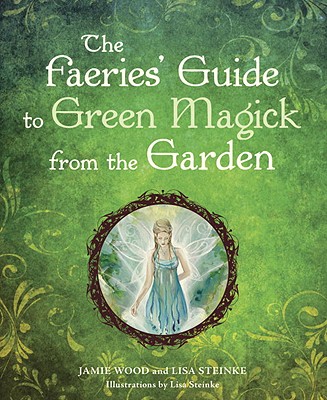
The Faeries' Guide to Green Magick from the Garden by Jamie Wood andLisa Steinke

This is a really interesting book on herbs and other plants. The book is not more than 200 pages so is obviously not as extensive as other herbal guide, but it's still very interesting.

The book states that a faerie is the life force of nature, plant energy if you will. The authors come to this conclusion because they say faeries can be found in nature, like dryads in trees, gnomes in hills, etc. The purpose of this book is essentially to merge meditation or a spiritual mentality with gardening, or what the authors call 'green gardening'.

Each herb's description is approximately 2 pages long and is accompanied with a picture of a faerie. What I really like about this book is that it isn't all spiritual or all medical, but it's a combination of both. The authors provide a short description of the plant and how to use/ store/ gather/ preserve it. Then they provide a short historical or mythological context for the plant and it's healing uses, home remedy like stuff. Then, after that, they give you a little recipe you can use the herb in or a recipe to make a product of some sort. As the book is not very long the author's do not get too deep into every plant and they give different information on different plants, but it's still a very interesting read.

Monday, 17 January 2011

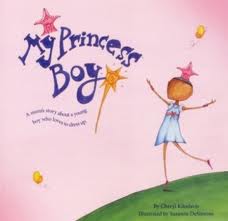
My Princess Boy by Cheryl Kilodavis

This book is  more an awareness book than it is a story. The mother of two boys narrates the book and she says that one of her sons is a princess boy. That means that he likes to dress up in dresses and crowns and other traditionally girly clothing instead of clothes boys usually wear. He also like to play games girls usually play. The book takes the reader through various activities the princess boy likes to do and near the end she says that though some people laugh at princess boy, she never will, and then she asks the audience if they will.

The book is a good example of spreading awareness. Not all boys like to play with trucks and bugs, that whole idea. It's effective in presenting its message and the pictures are bright and colourful and whimsical. A good choice to introduce gender identity or gender construction.

Monday, 10 January 2011

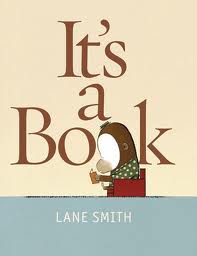
It's a Book by Lane Smith

This is a cute picture book mocking the ultra- techno society we seem to  becoming. The book is about a monkey and a donkey. The donkey is on his computer when he notices that the monkey has a weird rectangular thing made of paper in his hands. He then proceeds to ask him what it is and how to use it, but he keeps asking questions that would only apply to an electronic device. For example the donkey would ask 'how do you scroll down?' or 'does it need a password?' to which the monkey always replies 'it's a book'. It's a funny and playful reflection on the move from physical things to more digital medium.

Hey Nostradamus! by Douglas Coupland

This is a story about high school massacre in Vancouver in 1988 and how that massacre affected various characters in the novel, at least on the surface. More than this story being about a cause and effect play by play of an unfortunate event, it is about how people deal with situations with faith and the difference between religion and spirituality. Before I get ahead of myself here I would like to say that this book is not at all preachy, nor is it accusatory or abrasive. It is not so much a book about religion as it is a book about how people act when being 'religious' or not, and what that actually means. Each of the main characters in turn display a fervent belief and then a denial or realization that what they once believed may not be what they supposed it to be. Some people may not want to read this book because it has religion in it, and to those under that category I say that you will not be offended and will enjoy the book. To those who may read the book because it is about religion I want to say that it is more about individual interpretation and potentially exploitation for personal gain than it is a celebration of any faith, and you may be offended at some parts, but not deeply.

The novel is told through the eyes of four people, and each person was strongly impacted by the narrator before him or her. The story begins with two high school sweethearts, Cheryl and Jason, who love each other immensely and get secretly married (both because they love each other and because they want to have sex without committing a sin). Cheryl, the first narrator, became religious because she liked Jason and he was very religious (because of family reasons), but she soon come to strongly associate with the faith personally and throughout her segment of the story she speaks only to god, and we the audience over hear her prayers. Then one day a couple of youths from their high school hijack the school cafeteria with a couple of guns and kill some people, one of those people being Cheryl. Jason comes in to save her at the last minute and kills one of the terrorists, but is too late to save Cheryl.

Jason is the next narrator and we come into his life several years after the tragedy. Though Jason was seemingly religious in high school, he was so because of his father's fervent, almost nervous devotion to religion. His father was a very judgmental man and Jason could never seem to do anything quite good enough to satisfy him. After the massacre it was rumoured that Jason had planned the entire thing, and of course a majority of the town believed it. Even after he was proved innocent by the law and was named a hero by some of the papers his father could only see the fact that he'd killed a boy, no matter how many lives he might have saved in the process. Jason's account is very bitter in some places. The world had not been kind to him and he could not move on. Unlike the other narrators, Jason's account doesn't largely deal with his own personal relationship with religion. He talks more about how others relationships with religion have affected him, and how even though he isn't religious himself, he still falls back on some of the institutional rituals followed by people who believe.

The next narrator is named Heather, a woman who enters a sort of awkward relationship with and eventually marries Jason. Jason disappears shortly after her segment begins, and Heather deals with a psychic named Allison who seems to be in contact with Jason on some sort of spiritual level. This segment was interesting for me because it made me reflect on how people in contemporary, secular society seem to find pathways to express some sort of religious behaviour. Obviously believing in a psychic being able to contact individuals is a reflection of faith on some level. But more than the whole psychic thing, what was interesting to observe was Heather's behaviour and relationship with her desire to contact this person. Her need at these times were, while completely devoid of religion, were still strongly tied to faith. And what's more is I could associate her behaviour to what I've seen people feel while in a romantic relationship, or while at work, or studying, etc. That almost feverish desire is present in many aspects of life, not just religion, and that calls into question where one can draw the line between faith and religion. Or where one can start to separate faith and spirituality. Religion has a very defined identity in pop culture, and if you're not a card carrying member, the idea of it can be very unattractive. But how many of our day to day hopes and dreams and actions could be classified by an outsider as being likened to what we classify religious action? Just something to think about.

The last narrator is Jason's father, Reg. We hear many tales of this man throughout the novel, most of them unflattering. So by the time we get to hear him speak there is already a sort of prejudice against the man. Reg's account is more of a reflection than it is a narration or a tale recounted. He speaks of his faith, but in a refreshing way that I will not go into detail about.

I listened to this book aurally and I really enjoyed the voice actors. I thought the people chosen were well suited to their roles and were a pleasure to listen to. Overall this was a good book and I would recommend it.

Monday, 27 December 2010

Lantern Hill (1990)

Lantern Hill is based on the novel Jane of Lantern Hill by L.M. Montgomery, the same author who wrote Anne of Green Gables and Emily of New Moon. The movie was produced by Sullivan Entertainment, like Anne was, and just like Anne, this movie is a great find. I'm actually surprised I hadn't heard of it before acquiring it by chance and watching it. It really is very good.

The story follows a girl named Jane who lives in Toronto with her mother in the early 1900's. Her mother comes down with a serious illness however and Jane is forced to leave her middle class home to move in with her very wealthy grandmother while her mother recovers. Jane doesn't fit in very well here and, much to her grandmother's horror, would much rather spend her time in the kitchen or doing housework than socializing with other girls from elite families. She is also frequently bullied by her cousin who one day tells her that her father, whom she was told passed away, is alive. Her grandmother receives a letter soon after that from her father, requesting that Jane comes to live with him for a time in Prince Edward Island. Fearful of legal issues that could arise, her grandmother has no choice but to send her away. Jane of course goes along and, like many heroines in LMM books we get the sense that she isn't really wanted or needed (unlike many heroines though she does have both parents alive). Jane arrives and is picked up by her father's sister, who Jane seems not to gel with immediately. Jane meets her father, who is a writer, and he's a scatter brained person with a big dog and a house by the sea on Lantern Hill. At first she feels just as ostracized and out or place as she did back in Toronto, but as her relationship with her father gets a little better and she slowly settles into island life she feels happy. She also finds out that there is a potential woman in her father's life now, but he has never remarried since her mother. Jane of course wants her parents to reunite.

This movie is fantastic. It has the same level of production as Anne of Green Gables, but the story and character types are different so it has a different feel to it. Jane is a really great heroine. She's a good heroine because even though she loves doing domestic things (unpopular even today as something a woman should aspire to or even enjoy in some circles) she doesn't give in to the situations she's thrust into. She isn't very vocal about what she wants, but she stubbornly stays true to herself.

Also, a young Sarah Polley has a role in the film as a young scullery maid who befriends Jane. As fans may know, Sarah Polley stars in another successful Sullivan production called Road to Avonlea, which is a series featuring the town Anne was a part of, though she's not in the show at all.

Wednesday, 15 December 2010

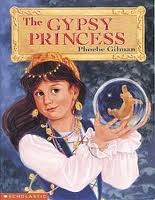
The Gypsy Princess by Phoebe Gilman

This is a cute story about a little gypsy named Cinnamon who is free-spirited and fun. She can play musical instruments and dance with bears, but what Cinnamon has always wanted is to see what it's like to be a real princess. One day her wish is answered when a princess comes to get her fortune told by Cinnamon. The princess is so entertained by Cinnamon that she invites her to come live in the palace. Cinnamon goes to live at the palace obviously and delights in the fancy dresses and parties, but after a while she starts to feel sad and misses the freedom she had as a gypsy. The princess soon tires of her and gets new companions and the gypsy girl starts to feel very homesick. So one day instead of letting the maid dress and fuss over her, she leaves the palace in search of her home. She finds the bear she used to dance with and takes down her hair hoping he'll recognize her, and of course he does and they begin to dance.

This is a great story for young girls because, especially for the 'girly' girls, being a princess is such a big deal. They dress up as princesses, obsess over Disney princesses, and want so badly to be a princess themselves, and it's good to let them explore that part of their imagination. It is also important to let them see or realize the goodness in themselves that they may not necessarily need to be a princess to be great, though playing can be fun.