Showing posts with label england. Show all posts

Thursday, 19 December 2013

Rebecca (1940)

Rebecca is a film about a young girl who meets a rich widower who falls in love with her while they're both in France, and then takes her home with him. When they get there, the young girl discovers that the late Mrs. De Winter, the man's first wife, is far from forgotten, and haunts everything and everyone at the great estate she is now the mistress of.

The new Mrs. De Winter is a timid girl and, after her whirlwind romance, is quite unprepared for the aristocratic life that she's signed on for. She can't quite seem to get used to the servants and the large house and the routine of a 'great lady', or at least can't do it in the way the late Mrs. De Winter, Rebecca, did it. In fact, she's bombarded with traces of Rebecca from the moment she first walks into the manor. Rebecca's initials are embroidered on everything, and the housekeeper, who seemed to have had a very strong attachment to Rebecca, always looks at her with a stern, almost disapproving gaze as she directs her in following Rebecca's footsteps. Her new husband, Maxim, also seems very distant, increasingly so as the pair get to know each other better. She feels like everyone is comparing her to the beautiful, intelligent, genteel Rebecca, and are finding her sadly lacking. What exactly are the details surrounding poor Rebecca's death? Will the new mistress ever find happiness in her new home, or win the love of her new husband? Will the memory of Rebecca haunt her and every other person in the house for eternity? Who knows!!

This was an amazing film. It was two hours long and I was enthralled from the get go. The acting was really well done. Our protagonist emotes such a nervous energy from the beginning of the film, and it morphs wonderfully into a stronger self-assuredness as the film nears its end and as she grows more confident in who she in and how she fits in to her situation. The way Rebecca was portrayed was also very well done. Even though we never once see her image nor are told directly or in great detail about her life, we are subtly made to know her character and traces of her are in almost every scene, and yet not enough to satisfy us. Just enough information about her is provided so as to ensure that the viewer is aware of her distinct importance and impact, but not enough to know in what regard, sparking wild curiosity. The cinematography was also very well done. At one point in the story as Mr. De Winters is reminiscing about Rebecca, the camera is aimed at a couch as he remembers the situation, and then it moves as though Rebecca is there and the camera is following her actions, but there's no one there. You can actually get into Maxim's mind's eye as he remembers, and are forced to imagine the memory he's sharing. Usually that kind of experience is reserved for books, or even radio, as flashbacks are typically shown in film leaving little to the imagination. Everything about Rebecca had to be imagined by the audience, which is what I think makes this film so special. It crosses a threshold in that respect and is truly a piece of art. It makes film not only something to idly watch, but something you can actually interact with and can put your own imagination to work. Brilliant.

This is a wonderful film full of suspense, romance, and mystery. I highly recommend it.


Sunday, 13 March 2011

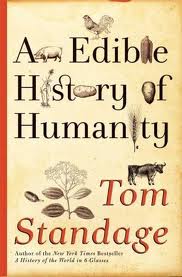
An Edible History of Humanity by Tom Standage

This book is an  interesting look at history from the perspective of how food has affected events in history. It's really refreshing to read about history in a way that isn't directed by political intrigue and war. So often that's the main focus in high school history class that it's difficult to remember that war and governmental disagreements weren't the only things going on in the past. Many more people might actually like history if it was told from different angles, and food is definitely something we can all understand.

The author begins by discussing the dawn of agriculture and how through farming foods like what we now know to be corn, we were able to form towns, cities, and even metropolises. Trade is discussed as is the migration of food from one place to another and how that effected its value, like Indian spices for the rest of the world. That value then inspired Columbus to travel to the Americas looking for a fast, cheap way to get spices and how he brought back foods like corn, potatoes, and more. Corn, wheat, and potatoes are discussed in terms of their value and, in the situation of the potato, how they had to overcome certain stigmas to be widely appreciated. Food is discussed as a crucial aspect of war, and how managing one's food supply gave one army the edge over another, or a country over its people. Food preservation and growing methods also changed the world, and now people use food origins as a social statement of sorts. There are several fascinating chapters from the dawn of man to present day.

The author doesn't say that certain events in history would not have eventually happened if food wasn't the main motivator, but that it was one of the pieces to many of the events that define our past. Food is such a crucial part of our existence; it literally sustains us. It makes sense to look at the role food has played in our decisions, past and present, because without it we wouldn't be. Having a basic knowledge of history will help you better understand the book and piece together the events, but the author writes quite well and describes the situations in some detail, so I'm sure you won't be completely lost if you have no knowledge at all. Overall, a really interesting book.

Also: I listened to this as an audio book, and it was well done, but the narrator has a whistling 's' that gets to be quite annoying. He also tries to do an accent for all of the quotations put into the book and fails at most of them. I'd say he was the worst part of the experience for me, but it's a good book so I recommend reading it.

Monday, 28 June 2010

Photographing Fairies (1997)

Photographing Fairies is a sci fi/ fantasy film set in the early 1900's exploring the idea behind the Cottingly fairy hoax. The story is about a young photographer named Charles Castle who looses his wife soon after they are married, and of course he is lost in his grief. He goes off to war and is employed as a photographer in the trenches, and after the war he is still consumed with death as we see him cut and paste photos of dead soldiers into new photos of their loved ones for a living. One day he finds himself at a supernatural convention of sorts and comes upon a lecture of a man telling people of the Cottingly photographs and supporting the existence of faeries because of them. Charles then proceeds to interrupt the man, telling him that there is no way the photos can be real, both from a photographers perspectives and as one who has lost faith with all things the eye cannot see. The character of Sir Arthur Conan Doyle makes an appearance in the film, as he was a supporter of the photos, even though he wasn't so supportive of them in the film. So, after attending the lecture, a woman comes to his studio and shows him some photographs that were supposedly of a real faerie standing on her daughter's outstretched hand. Of course Charles doesn't believe this any more than he believed the Cottingly story, but after closer inspection he finds that there is something not quite right about the photo and goes off to find the woman and ask her about it. The woman lives in the countryside with her husband, a pastor, their two daughters, and the governess for the girls. He finds the woman and tells her that he may believe her story, but she just smiles at him and tells him that the photograph doesn't matter anymore because she has seen them. The details after this point I will not go into because that is where the real mystery lies.

Charles struggles throughout the movie with his wife's death and cannot seem to get beyond the hold it has on him. Maybe because of this he has lost all faith in an after world or possibilities of another world within ours, until of course he goes in search of the faeries. When he does find a way to see them (whether or not he's hallucinating is debatable) he clings to this connection ferociously and uses this to try to get in touch with his wife. At the end he is somewhat set free of this, and embarks on an adventure of sorts.

This is not a film for children, or if a child does see it, it should be monitored by a parent. There is both nudity and death in the film, and though neither appear in excess, I would say this is a 14 and up movie.