Showing posts with label history. Show all posts

Thursday, 9 January 2014

Stories We Tell (2012)

This is a genealogical documentary by Sarah Polley. A good portion of the film is spent listening to different people speak about Polley's deceased mother, Diane, and events surrounding her own birth. Polley interviews her father, her siblings, step-siblings, potential lovers of her mother, and her mother's friends. Through all of this we get an idea of the vibrant, energetic woman who was Diane Polley, the impact she had on others, and the impact they had on her.

While the family history is all fine and well, it is not exactly a thrilling film. It's essentially a slow-paced sleuthing process recounting memories strangers have of a mutual connection. Interesting, but not exactly thrilling. Then, in the latter half of the film, close to the end, Polley does something pretty interesting and reflects on the possibility of being able to capture a true memory of her mother. If it is indeed possible to really know her mother, or understand these past events. She poses the question to a couple of her interviewees and receives some interesting ideas about the nature of memory and whether or not a memory can be truly universally shared. There is an interesting statement put forward that, no matter how 'organic' a memory is, it still undergoes an editing process of sorts when it's shared. It is polished and touched up and segments may be removed or modified to suit the situation, and Polley does a remarkable job of echoing this sentiment throughout the entirety of the film. Before, during, and after the shooting of the documentary, we see establishing shots. People getting ready to be interviewed, cameras or lighting equipment, and even shots or Polley herself as she is directing the picture. On more than one occasion, the idea of the 'fourth wall' is broken down and the audience is acutely aware of the fact that this film is being manufactured, but that it is still an essential truth. She also reflects on her own motivations for pursuing this project, once we learn the some key details of the story, and we are let into a very personal and private portion of this person's life. Polley is really opening herself up to the world with this film, at least in terms of the details surrounding her early childhood and birth.

A side note on Sarah Polley and my bias toward her. I really like Sarah Polley. I was first introduced to her through the Road to Avonlea series (phenomenal), and have seen her in various other productions since then. RTA was taken on by Disney after the first or second season, and ended up letting Polley go because of her political activism and refusal to give into the corporation when they told her to stop. When most of the Disney child stars I can think of off the top of my head end up getting into some of the less than ideal situations, I can only think extremely highly of a person who possessed too much moral integrity for Disney to stand. I also just think that she's a very talented and genuine actor and director, and am usually inclined to think that whatever she's affiliated with is bound to be interesting. And it usually is. But that's just me.

Anyway, the story is not only interesting, but she takes it to another level. Ultimately worth the watch.


Sunday, 13 March 2011

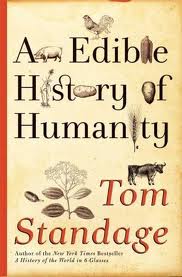
An Edible History of Humanity by Tom Standage

This book is an  interesting look at history from the perspective of how food has affected events in history. It's really refreshing to read about history in a way that isn't directed by political intrigue and war. So often that's the main focus in high school history class that it's difficult to remember that war and governmental disagreements weren't the only things going on in the past. Many more people might actually like history if it was told from different angles, and food is definitely something we can all understand.

The author begins by discussing the dawn of agriculture and how through farming foods like what we now know to be corn, we were able to form towns, cities, and even metropolises. Trade is discussed as is the migration of food from one place to another and how that effected its value, like Indian spices for the rest of the world. That value then inspired Columbus to travel to the Americas looking for a fast, cheap way to get spices and how he brought back foods like corn, potatoes, and more. Corn, wheat, and potatoes are discussed in terms of their value and, in the situation of the potato, how they had to overcome certain stigmas to be widely appreciated. Food is discussed as a crucial aspect of war, and how managing one's food supply gave one army the edge over another, or a country over its people. Food preservation and growing methods also changed the world, and now people use food origins as a social statement of sorts. There are several fascinating chapters from the dawn of man to present day.

The author doesn't say that certain events in history would not have eventually happened if food wasn't the main motivator, but that it was one of the pieces to many of the events that define our past. Food is such a crucial part of our existence; it literally sustains us. It makes sense to look at the role food has played in our decisions, past and present, because without it we wouldn't be. Having a basic knowledge of history will help you better understand the book and piece together the events, but the author writes quite well and describes the situations in some detail, so I'm sure you won't be completely lost if you have no knowledge at all. Overall, a really interesting book.

Also: I listened to this as an audio book, and it was well done, but the narrator has a whistling 's' that gets to be quite annoying. He also tries to do an accent for all of the quotations put into the book and fails at most of them. I'd say he was the worst part of the experience for me, but it's a good book so I recommend reading it.

Monday, 19 July 2010

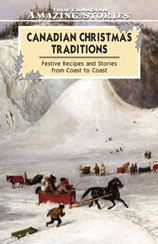
Canadian Christmas Traditions by DeeAnn Mandryk

I came across this book in my local book store and initially thought it would be an eclectic collection of stories that no one would really care to read about... but I very happily discovered otherwise. This book is a wonderful resource for the origins of all of the things we now take for granted come Christmas. There are recipes in the book, but I do not cook or bake so I do not really care about them nor took the time to look them over, but there were a good number of them and I'm sure they would be of interest to those who do have an interest in both the culinary arts and the holiday season.

The book has pretty much every Christmassy thing in here and discusses both where it came from and how we use it currently. It covers a lot of ground so the information about some of the traditions are not as in-depth as others, some are only a page in length, but there is enough information on each topic to satisfy your average information junkie.

This is the table of contents in list form to give an idea of the subject matter;

Intro, The Origin of Christmas Day, Christmas and Xmas, The Christmas Tree, Christmas Ornamentation and Decorations, The Christmas Star, Holiday Flora, Yule Logs, Christmas Candles and the Festival of Lights, Origin of Advent, Colours of the Season, Christmas Bells, Feasting Traditions, Canadian Christmas Traditional Recipes, Origin of Christmas Crackers, First Christmas Carols, The Origins and Evolution of Santa Claus, Reindeer Names, Christmas Stockings, Christmas Presents, Origin of the Snowman, The Nutcracker, The Importance of Frankincense, Origin of the Creche, The Night Animals Could Speak, The Origin of Christmas Cards, Beginnings of Boxing Day, The Three Wise Men, Groundhog Day and Candlemas, Old Slavic Winter Solstice and Christmas Superstitions

I have always been interested in tradition and in the origins of both my belief and my culture. I would look up the history online and print out pages to show to my family. I no longer have to do that because this book has all of that information compiled into one super convenient and interesting book. It is very readable and easy to get through and a must for all Christmas enthusiasts out there.

Tuesday, 1 September 2009

Where the Spirit Lives (1991)

This is a movie about residential schools in early North America. Residential schools are essentially schools set up by christian churches in early North America with the sole purpose of purging Native Americans of their language/ heritage/ pride/ what have you. Children were taken from their families and forced to attend these schools wherein they were forced to conform to the European way of life. Many children were severely abused and sadly the last residential school was closed down only 10 or 20 years ago, so this is by no means an issue from the distant past.

I first saw this movie in late elementary school early/ high school (on my own time) and it really opened my eyes. Up until that point I'd enjoyed a much happier view of Native American people, relying more on fiction than anything else. And while fiction is based on fact and there are some very good aboriginal fiction books out there, the one's I read were set in the past and painted a proud, concrete glorification of the culture and didn't really mention the current state of Aboriginals in North America. And in school we don't learn too too much about this aspect of history (history as told by the conquerors I suppose) just that Nunavut was created as a territory solely for the use of the aboriginal people, which is nice, but in elementary school they don't tell you why that step was necessary, or not in much detail anyway.

The story here is about an aboriginal girl who, along with her younger brother, were kidnapped by a white pilot and brought them to a residential school to live. We are given the pg version of the story and more of the abuse is suggested rather than shown, but several reviewers of this movie stated that it is an accurate depiction of residential school life, speaking from their supposed personal experiences. The girl in the movie does end up escaping from the school, but not many children were as lucky as this, and keeping movies like this around is an important step in remembering the wrongs of the past to ensure they never happen again.

The heroine of this film was very strong and resilient and she didn't loose her culture to the one being forced upon her in the residential school. Overall this was very well done.


The Wild Irish: A Novel Of Elizabeth I And The Pirate O’malley by RobinMaxwell

I got this book anticipating adventure, excitement.. something amazing. Two powerful and notable women from English/ Irish history are coming together, there's potential for a great story. Instead this book was written like a documentary... a very slow paced documentary. I lost interest after the first couple of chapters but dragged myself to the halfway mark, and at that point I could care less about the characters and wasn't at all involved in the story line, so dropped it for something better. History is such a fascinating topic but is destroyed for a lot of people by teachers who make it very much less than it should be. Because of my expectations, this book was the equivalent of that teacher.

As I do enjoy the actual history, I suppose I could see how someone could get something out of the book... not too much, but something about two notable historical women. This is definitely isn't my ideal for a good fiction book, nor a good representation of stories and historical figures who were actually extremely fascinating and worth writing about.

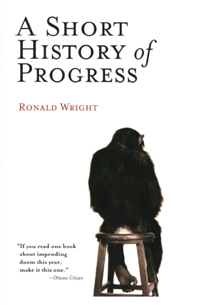
A Short History Of Progress by Ronald Wright

This was an interesting book discussing the possibility of collapse. Wright makes a point that there is a tendency for something to bring itself to an end, whether this is intentional or not. There is the unintentional way, say, the dying out of a species of animal. Sometimes a species or group of people just can't cope with a change and they die out, like the sabre toothed tiger, as wright discusses. Sabre toothed tigers survive on big game, that's why they need those big teeth to rip into the huge animals, but those teeth get in the way if they were hunting say a rabbit, so as big game died out so did they. But the other kind of extinction, the one more relevant to us today, us being the leading countries with the power to carry out wright's fears, is very much intentional. An example from wright explaining this is the Easter Islanders... there were a few but I like this one best because it makes it more real for me as I live in suburbia. The Easter Islanders cut down all the trees on their island and because of the implications of that, went extinct. That might sound kind of ridiculously basic to us, but we're doing the exact same things today. Wright calls these progress traps and examples would be farming and nuclear weapons. We have become so dependent on farming and use that solely to produce food that if the climate were to change we'd be in something of a pickle.. and I'd assume you can guess how nuclear weapons would hinder the progress of the human species. Wright brings our attention to our possible demise by our own hand. A decent quote is "the most compelling reason for reforming our system is that the system is in no one's interest. It is a suicide machine".

It's not so much a history book as it is a call to attention. It uses history to explain the theories it proposes, because history is all we have, but it is not an all encompassing guide to the progress of humanity throughout time. I thought it was a pretty good book, readable.


Friday, 17 July 2009

The Story of Wine by Hugh Johnson

A comprehensive guide to the history of wine. Grape wine that is, they don't go much into sake or wines made from other products, though some are mentioned. It goes through many countries and time periods and was overall very readable for a history text.

Thursday, 16 July 2009

The Celts: A History by Peter Berresford Ellis

This was a great introduction to Celtic history. It's written in a very readable way and covers many aspects of the ancient Celtic way of life. It even has a few pictures. I would recommend this to anyone interested in the ancient Celts.