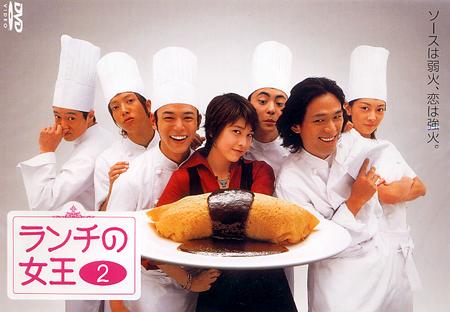
This is a Japanese drama about a young woman who really loves food. Her life isn't the best. She works at a cafe, really just putting the hours in, but really doesn't care about the work. What she does care about however, is when lunchtime comes around. She will do whatever it takes to take her lunch on time, and when that time does, she goes on a hunt for the best lunch in town. She even keeps a book full of notes on the places she's tried. It's just another day for Natsumi when, on her very precious lunch break, a strange man pulls her into an alley and begs her to come home with him, pretending to be his wife. He says that his father is dying and he wants to see him one last time, but he'll be so disappointed if he doesn't bring home a wife, she would only have to pretend for the day, etc. Natsumi is having none of it... until the guy says that he will give her the best omurice (rice omelet) that she's ever tasted, so she goes.
As it turns out, this guy's family runs a restaurant, and he's just back to con them out of some cash. Because Natsumi took pity on this guy, she lost her job at the cafe, and without that has no way to pay for her apartment. In addition, she has a very strong love for food, and fell in love with the restaurant's flavour. So she goes back to the restaurant, claiming that as their brother's fiancée, they have to help her. She will work at the restaurant until that guy comes back. At first, the brothers are understandably having none of it. But they slowly warm up to her, especially Jun, who develops a crush on her. She tries her best to do her job well, and she eats with such gusto that they can't help but enjoy her presence. As she lives with them, she learns more about the family and their struggles to continue the business and preserve their unique flavour. At the same time, Natsumi runs in with some people she used to know, people in a bad crowd, and she has to juggle the two worlds. Will her 'fiancee' ever come back to fix the mess he made? If he does, will he have to fight off his younger brother for Natsumi's supposed affection? Will Natsumi be able to hold on to this world she find increasingly dear to her? Watch to find out!
I liked this drama. The characters are all fun and energetic and genuine. As with most of these shows, they really try to capture that 'artist' essence and the importance to try hard and give it your all, which can be heartwarming. The biggest thing though, is that this show makes me hungry. I wouldn't be lost walking into a Japanese restaurant, but I've never been to Japan and have not tried 'authentic' Japanese food. I've never had an omurice, but watching this show... I want one.
You can watch the first episode here. http://www.gooddrama.net/japanese-drama/lunch-queen-episode-1
Showing posts with label food. Show all posts
Tuesday, 3 December 2013
Sunday, 13 March 2011
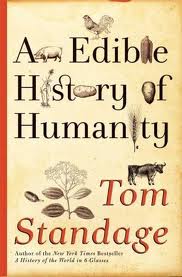
An Edible History of Humanity by Tom Standage
This book is an interesting look at history from the perspective of how food has affected events in history. It's really refreshing to read about history in a way that isn't directed by political intrigue and war. So often that's the main focus in high school history class that it's difficult to remember that war and governmental disagreements weren't the only things going on in the past. Many more people might actually like history if it was told from different angles, and food is definitely something we can all understand.
The author begins by discussing the dawn of agriculture and how through farming foods like what we now know to be corn, we were able to form towns, cities, and even metropolises. Trade is discussed as is the migration of food from one place to another and how that effected its value, like Indian spices for the rest of the world. That value then inspired Columbus to travel to the Americas looking for a fast, cheap way to get spices and how he brought back foods like corn, potatoes, and more. Corn, wheat, and potatoes are discussed in terms of their value and, in the situation of the potato, how they had to overcome certain stigmas to be widely appreciated. Food is discussed as a crucial aspect of war, and how managing one's food supply gave one army the edge over another, or a country over its people. Food preservation and growing methods also changed the world, and now people use food origins as a social statement of sorts. There are several fascinating chapters from the dawn of man to present day.
The author doesn't say that certain events in history would not have eventually happened if food wasn't the main motivator, but that it was one of the pieces to many of the events that define our past. Food is such a crucial part of our existence; it literally sustains us. It makes sense to look at the role food has played in our decisions, past and present, because without it we wouldn't be. Having a basic knowledge of history will help you better understand the book and piece together the events, but the author writes quite well and describes the situations in some detail, so I'm sure you won't be completely lost if you have no knowledge at all. Overall, a really interesting book.
Also: I listened to this as an audio book, and it was well done, but the narrator has a whistling 's' that gets to be quite annoying. He also tries to do an accent for all of the quotations put into the book and fails at most of them. I'd say he was the worst part of the experience for me, but it's a good book so I recommend reading it.
The author begins by discussing the dawn of agriculture and how through farming foods like what we now know to be corn, we were able to form towns, cities, and even metropolises. Trade is discussed as is the migration of food from one place to another and how that effected its value, like Indian spices for the rest of the world. That value then inspired Columbus to travel to the Americas looking for a fast, cheap way to get spices and how he brought back foods like corn, potatoes, and more. Corn, wheat, and potatoes are discussed in terms of their value and, in the situation of the potato, how they had to overcome certain stigmas to be widely appreciated. Food is discussed as a crucial aspect of war, and how managing one's food supply gave one army the edge over another, or a country over its people. Food preservation and growing methods also changed the world, and now people use food origins as a social statement of sorts. There are several fascinating chapters from the dawn of man to present day.
The author doesn't say that certain events in history would not have eventually happened if food wasn't the main motivator, but that it was one of the pieces to many of the events that define our past. Food is such a crucial part of our existence; it literally sustains us. It makes sense to look at the role food has played in our decisions, past and present, because without it we wouldn't be. Having a basic knowledge of history will help you better understand the book and piece together the events, but the author writes quite well and describes the situations in some detail, so I'm sure you won't be completely lost if you have no knowledge at all. Overall, a really interesting book.
Also: I listened to this as an audio book, and it was well done, but the narrator has a whistling 's' that gets to be quite annoying. He also tries to do an accent for all of the quotations put into the book and fails at most of them. I'd say he was the worst part of the experience for me, but it's a good book so I recommend reading it.
Subscribe to:
Posts (Atom)