Saturday, 26 March 2011

Miss Grant Takes Richmond (1949)

This is a screw-ball comedy starring Lucille Ball as the klutzy, energetic, seemingly dull-witted stenographer, Miss Grant. She was at the bottom of her stenography class and had a very low chance of graduating, but on the day of her last class a business man came to her class to choose a secretary, and of all of her more qualified classmates he chooses her to work in his office! She is excited and ready to work hard for her new employer at what she thinks is a real estate office. Little does she know her new employer is just using real estate as a cover and he and his associates are actually bookies. They only chose Miss Grant because she seemed to be the stupidest girl in her class, and wouldn't figure out what they were up to.

Much to the chagrin of her new employers, Miss Grant charges headlong into the business. She finds clients and even sets up a deal for the company to buy a large and expensive piece of land to build houses on. They try to get rid of her, but when that fails due to her sense of duty to the people she's trying to help, they put her in charge of an operation doomed to failure. Things seem to be going downhill until Mr. Richmond's conscience kicks in and decides to sell himself into the service of his former associates in order to bail out Miss Grant. She then goes off to save him.

The film is very funny. To those who enjoyed the I Love Lucy tv show, this is the same kind of comedy. Miss Grant is a very strong, proactive heroine. Even though she isn't the best at what she does she struggles hard to try to find a place for herself in the world before succumbing to the life of a housewife, as is expected of her. She attacks any assignment given to her whole-heartedly, and even though she can be a bit slow at times, she has a good heart which endears her to the audience.


Sunday, 13 March 2011

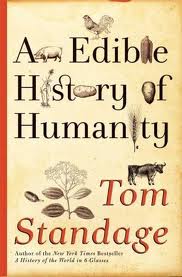
An Edible History of Humanity by Tom Standage

This book is an  interesting look at history from the perspective of how food has affected events in history. It's really refreshing to read about history in a way that isn't directed by political intrigue and war. So often that's the main focus in high school history class that it's difficult to remember that war and governmental disagreements weren't the only things going on in the past. Many more people might actually like history if it was told from different angles, and food is definitely something we can all understand.

The author begins by discussing the dawn of agriculture and how through farming foods like what we now know to be corn, we were able to form towns, cities, and even metropolises. Trade is discussed as is the migration of food from one place to another and how that effected its value, like Indian spices for the rest of the world. That value then inspired Columbus to travel to the Americas looking for a fast, cheap way to get spices and how he brought back foods like corn, potatoes, and more. Corn, wheat, and potatoes are discussed in terms of their value and, in the situation of the potato, how they had to overcome certain stigmas to be widely appreciated. Food is discussed as a crucial aspect of war, and how managing one's food supply gave one army the edge over another, or a country over its people. Food preservation and growing methods also changed the world, and now people use food origins as a social statement of sorts. There are several fascinating chapters from the dawn of man to present day.

The author doesn't say that certain events in history would not have eventually happened if food wasn't the main motivator, but that it was one of the pieces to many of the events that define our past. Food is such a crucial part of our existence; it literally sustains us. It makes sense to look at the role food has played in our decisions, past and present, because without it we wouldn't be. Having a basic knowledge of history will help you better understand the book and piece together the events, but the author writes quite well and describes the situations in some detail, so I'm sure you won't be completely lost if you have no knowledge at all. Overall, a really interesting book.

Also: I listened to this as an audio book, and it was well done, but the narrator has a whistling 's' that gets to be quite annoying. He also tries to do an accent for all of the quotations put into the book and fails at most of them. I'd say he was the worst part of the experience for me, but it's a good book so I recommend reading it.
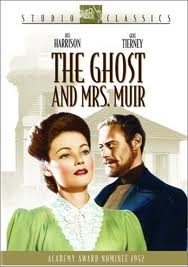
The Ghost and Mrs. Miur (1947)

This film is about a woman named Lucy Miur whose husband has died. To the disapproval of her late husband's mother and sister, she decides to take her young daughter and maid and move out to the sea-side. When she gets there she falls in love with an old house. The landlord strongly suggests that she find another house because the one she has chosen is haunted, but she will not be swayed and rents it out. On the first night there, Lucy notices something wrong with the lights. After trying to light a candle for the 4th or 5th time, she gets frustrated and fearfully, but determined, she yells out into the darkness of the room, taunting the ghost to come out of hiding and face her. And of course when she turns around she comes face to face with a distinguished sea-captain who tells her that she should leave. The two form a unique friendship, that develops into something a bit deeper for the ghost. Lucy's in-laws come to visit her and tell her that the she doesn't have any more money and should just come home with them instead of continuing to live alone in this old house. She turns them away rudely, because she's talking to the ghost at the same time and of course only she can see him. This leaves Lucy in somewhat of an awkward position because she won't be able to afford her rent anymore. The ghost convinces her to stay and that he'll take care of everything. His idea is to have her write down his life and adventures on the seas in what he believes will be a best-selling volume. She does this and is well received by the publisher and receives a large check for her troubles. While there she also meets another author who has it in his mind to court her. The ghost sees this and is jealous of the man's ability to physically be with Lucy. Is the man what he really seems to be? And will Lucy choose to keep company with the living or the dead?

This was a really great movie. It's the story of a woman setting out on her own and trying to make a life for herself after the death of her husband, instead of withering away in mourning as her in-laws would wish. Lucy is a sickly woman and is used to combating the odds, even with her own body, so striking out on her own and even publishing a novel to support herself and her family was just another obstacle for her to overcome. I thought the acting was really well done, and Lucy's daughter is the little girl from miracle on 34th street, so a familiar face for those who watch the Christmas specials every year.


Saturday, 12 March 2011

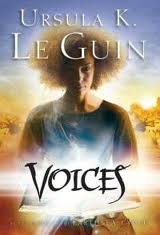
Voices by Ursula le Guin

This is the story about an adolescent girl named Memer. She lives in a city that was conquered by the Alds when she was born and has only known living in an occupied country. Her people were known by other places as a great place for learning and for the world's most comprehensive library, but the Alds feared the written word and believed that it held demons. They also feared the many gods Memer's people worshiped and called them all demons. The Alds had one god they obsessively worshiped, and were fearful of anything else. Ever since she was a girl, Memer often escaped to a secret room in the large house she lived in. Her mother took her there when the city was first being attacked to protect her, as the room was hidden and could only be open by a series of hand movements. The Waylord, the elected leader of their people, found her there and taught her to read. He also shares a house with Memer and becomes a sort of surrogate father for her (Her mother died in the attacks when she was small and she never knew her father as he was an Ald, and though it is very vaguely hinted at, Memer's mother was raped, but chances are most people whom the book is targeted for will miss this fact).

Then one day a storyteller (called a maker in the story) and his companion come to the city. Memer feels an instant draw to these people and, after an incident in the town square, invite them to stay as guests in the Waylords house. The Alds value the spoken word as it turns out and have the maker come to them to tell stories and sing songs. It is with the arrival of these two people that the situation slowly begins to shift. Through Memer, the reader gets to see a little bit more of the Alds, but not too much as Memer's anger toward them is so strong. There are whispers of a revolution, and Memer finds out that there is more to the secret room and the books there than she first thought. Will Memer and her people ever be free of the Alds?

I thought this was a very well written book with an intriguing story line. It is a story about overcoming hatred, fear, and ignorance to find knowledge and truth. I found Memer to be a likeable character, though she was often held back by anger or fear. The role of books and reading was also interesting. They were forbidden and seen as being evil magic by the Alds, and while this seems like make-believe, there are some people who believe books are bad, not because reading is an evil magic ability, but because of the ideas they can give you. I  like Ursula le Guin but it took me a really long time to pick this book up because the cover looks kind of cheesy. However, just another lesson in not judging books by their covers, it was a good parable for finding strength in truth and knowledge.

Thursday, 24 February 2011

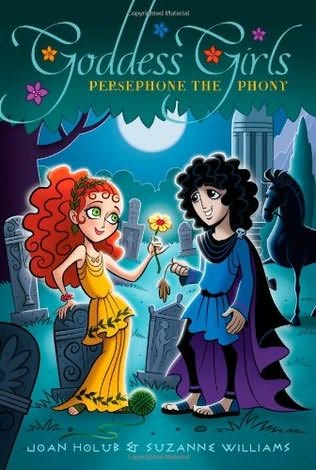
Persephone the Phony (Goddess Girls) by Suzanne Williams and Joan Holub

Goddess Girls is a cute series for young girls about goddesses from Greek mythology, namely Persephone, Athena, Aphrodite and Artemis. This is the first book I've read in the series and I was drawn to it because I've always liked the story of Persephone and Hades, and though the story is called 'The Rape of Persephone' I've always considered it to be more of a forbidden love story than Hades taking her against her will.

The goddesses in this series are 12, the supposed age of the potential reader and all of the gods and goddesses interact mostly at god- school, with Zeus as the principle. Persephone is a shy girl and always goes along with what her friends want to do or are interested in instead of saying what she would like to do, and because she is always going along with her friends and hides her real feelings she starts to think of herself as being phony. Then one day after school, Aphrodite convinces Persephone and Athena to go shopping with her. She is convinced to buy a ball of yarn (among other things) and on her way home she drops the yarn and it unravels and falls down to earth to a cemetery. Persephone goes after it and when she gets to the cemetery she is intrigued by it, as she has never been to one, and she finds that she feels very calm in this place. Then, the ground shakes and opens up and out comes a young Hades on a black stallion. They get to talking and Persephone finds that Hades is quite a nice person and inspires her to say what she's really feeling, but alas the meeting is interrupted by Demeter, Persephone's mother, who gets angry at Persephone for not telling her where she had gone. As the story progresses, Persephone and Hades have a few more chance encounters (almost every time someone warns her away from him) and Persephone starts feeling like she should stand up for herself more. Aphrodite asks her to go shopping again and this time she refuses and goes to see Hades instead, but on the way there she sees a pomegranate orchard and stops in for a bite.  Hades comes up and they have some fun spitting the seeds but as it turns out her friends were spying on her and tell her mother what she's been up to. Persephone is angry at everyone for this invasion of privacy and runs away to the underworld with Hades (instead of being dragged) and tells him that she's tun away and wants to live with him. In contrast to the myth, he actually sends her back however, telling her that the underworld isn't a place for her and that her mother would be worried. Persephone has a talk with her mom and then seeks Hades out at school the next day and he asks her to go to a dance.

It's not exactly the myth, but the main pieces are in the right place. They meet on earth, and Persephone's making a daisy chain at the time, so she's still interacting with nature at some level when he meets her. The pomegranate is still the turning point in their relationship, after that she begins to act more in her own interest instead of going along with what other people say, and after that point they end up getting together. And she did go down into the underworld, she was just sent swiftly back to mount Olympus. Overall it was an enjoyable read and a fun interpretation.. and maybe an introduction for some kids, to some of the more well-known female goddesses in Greek mythology. I haven't read any of the other books, but this one was pretty good so I would think those are ok as well.

Saturday, 19 February 2011

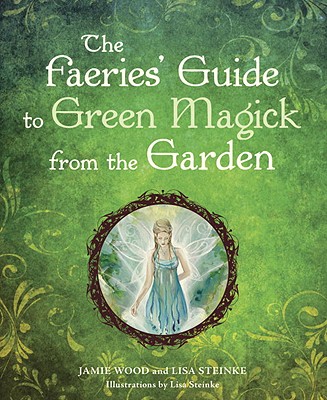
The Faeries' Guide to Green Magick from the Garden by Jamie Wood andLisa Steinke

This is a really interesting book on herbs and other plants. The book is not more than 200 pages so is obviously not as extensive as other herbal guide, but it's still very interesting.

The book states that a faerie is the life force of nature, plant energy if you will. The authors come to this conclusion because they say faeries can be found in nature, like dryads in trees, gnomes in hills, etc. The purpose of this book is essentially to merge meditation or a spiritual mentality with gardening, or what the authors call 'green gardening'.

Each herb's description is approximately 2 pages long and is accompanied with a picture of a faerie. What I really like about this book is that it isn't all spiritual or all medical, but it's a combination of both. The authors provide a short description of the plant and how to use/ store/ gather/ preserve it. Then they provide a short historical or mythological context for the plant and it's healing uses, home remedy like stuff. Then, after that, they give you a little recipe you can use the herb in or a recipe to make a product of some sort. As the book is not very long the author's do not get too deep into every plant and they give different information on different plants, but it's still a very interesting read.

Monday, 17 January 2011

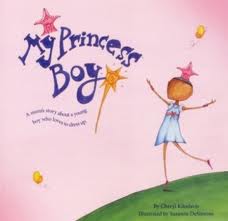
My Princess Boy by Cheryl Kilodavis

This book is  more an awareness book than it is a story. The mother of two boys narrates the book and she says that one of her sons is a princess boy. That means that he likes to dress up in dresses and crowns and other traditionally girly clothing instead of clothes boys usually wear. He also like to play games girls usually play. The book takes the reader through various activities the princess boy likes to do and near the end she says that though some people laugh at princess boy, she never will, and then she asks the audience if they will.

The book is a good example of spreading awareness. Not all boys like to play with trucks and bugs, that whole idea. It's effective in presenting its message and the pictures are bright and colourful and whimsical. A good choice to introduce gender identity or gender construction.